

Bilingual Toddlers: Does Learning Two Languages Delay Speech?
Mixing languages isn’t confusion—it’s progress. Discover why bilingual toddlers may talk differently, but not late, and how to support healthy speech development.
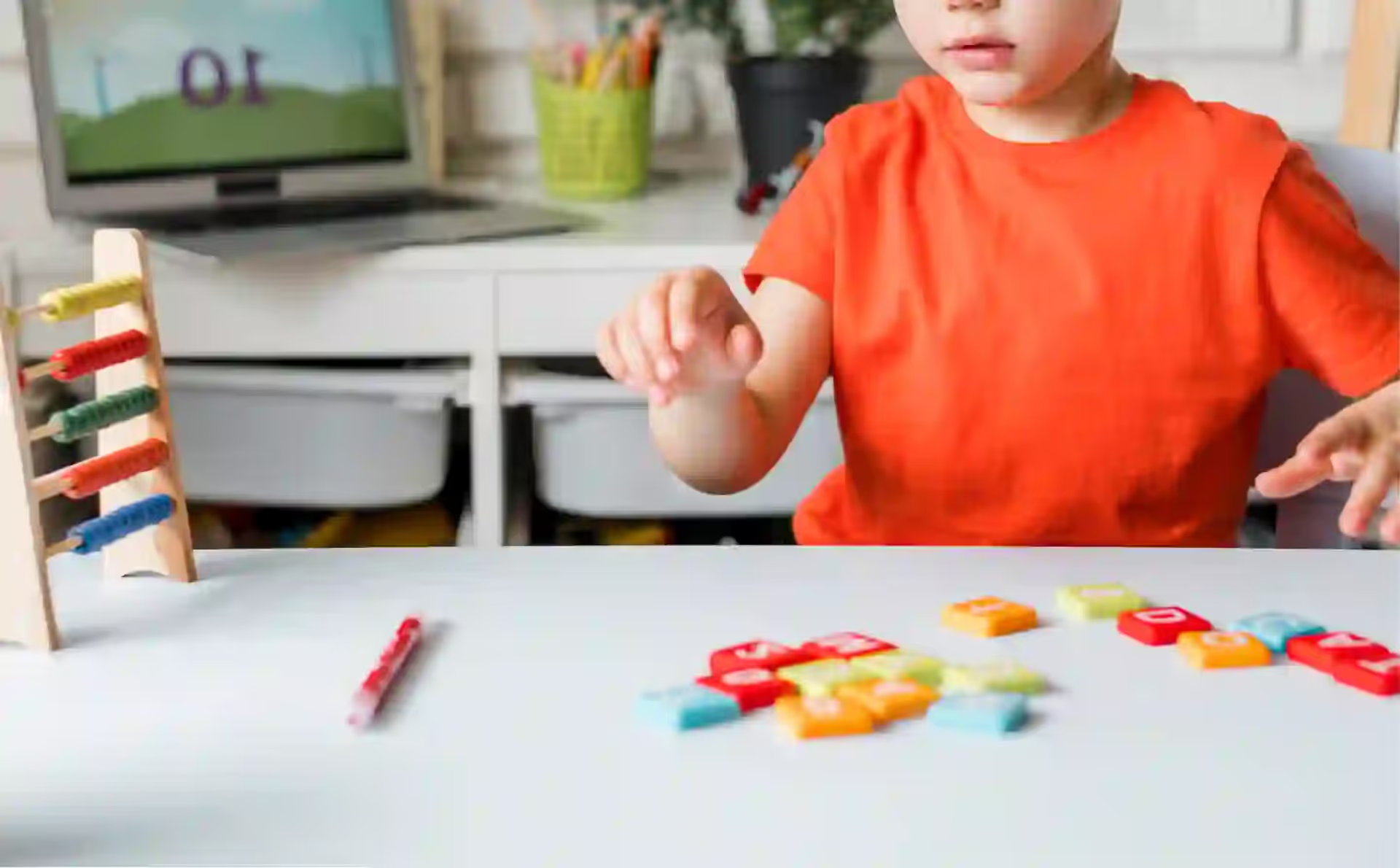
Four-year-old James is building a tower. He stacks blocks precariously, watches it wobble, laughs when it crashes, and immediately starts rebuilding—higher this time. His mother watches from across the room, laptop open, and a familiar anxiety creeps in: Should we be doing flashcards instead? His preschool friends are already reading. Shouldn't we be working on letters?
This is the central tension of modern early childhood: in a culture increasingly obsessed with early academics, measurable outcomes, and educational "progress," play looks suspiciously like wasted time. It looks frivolous. It looks like what children do when they're not learning.
Except it isn't.
The uncomfortable truth that decades of neuroscience, developmental psychology, and educational research have revealed is this: play is not the opposite of learning. Play is not what happens when learning stops. Play is the most powerful vehicle for learning that evolution has produced. When a child is deeply engaged in play, their brain is doing exactly what it needs to do to build the neural architecture for everything that matters—not just academic skills, but executive function, creativity, emotional regulation, social competence, and resilience.
The block tower that looks like simple fun? It's teaching spatial reasoning, physics concepts, problem-solving, frustration tolerance, and iteration—all core cognitive skills that will serve James throughout his life. The pretend play that seems like imagination run wild? It's building literacy foundations, social cognition, emotional intelligence, and narrative thinking. The running, jumping, and climbing that appears to be burning off energy? It's developing executive function, body awareness, risk assessment, and mood regulation.
Modern science has given us clear, compelling evidence that play is a powerful engine for cognitive, social, and emotional development. But this message struggles to penetrate a culture that increasingly believes childhood is a race, that earlier is better, that play is what happens after the real work is done.
This article will unpack the science behind play-based development, dismantle the myths that lead us to undervalue play, and provide concrete guidance for protecting and promoting high-quality play at home and in schools. By the end, you'll understand why that chaotic block tower represents one of the most sophisticated learning experiences available to young children—and why play might be the most important work of childhood.
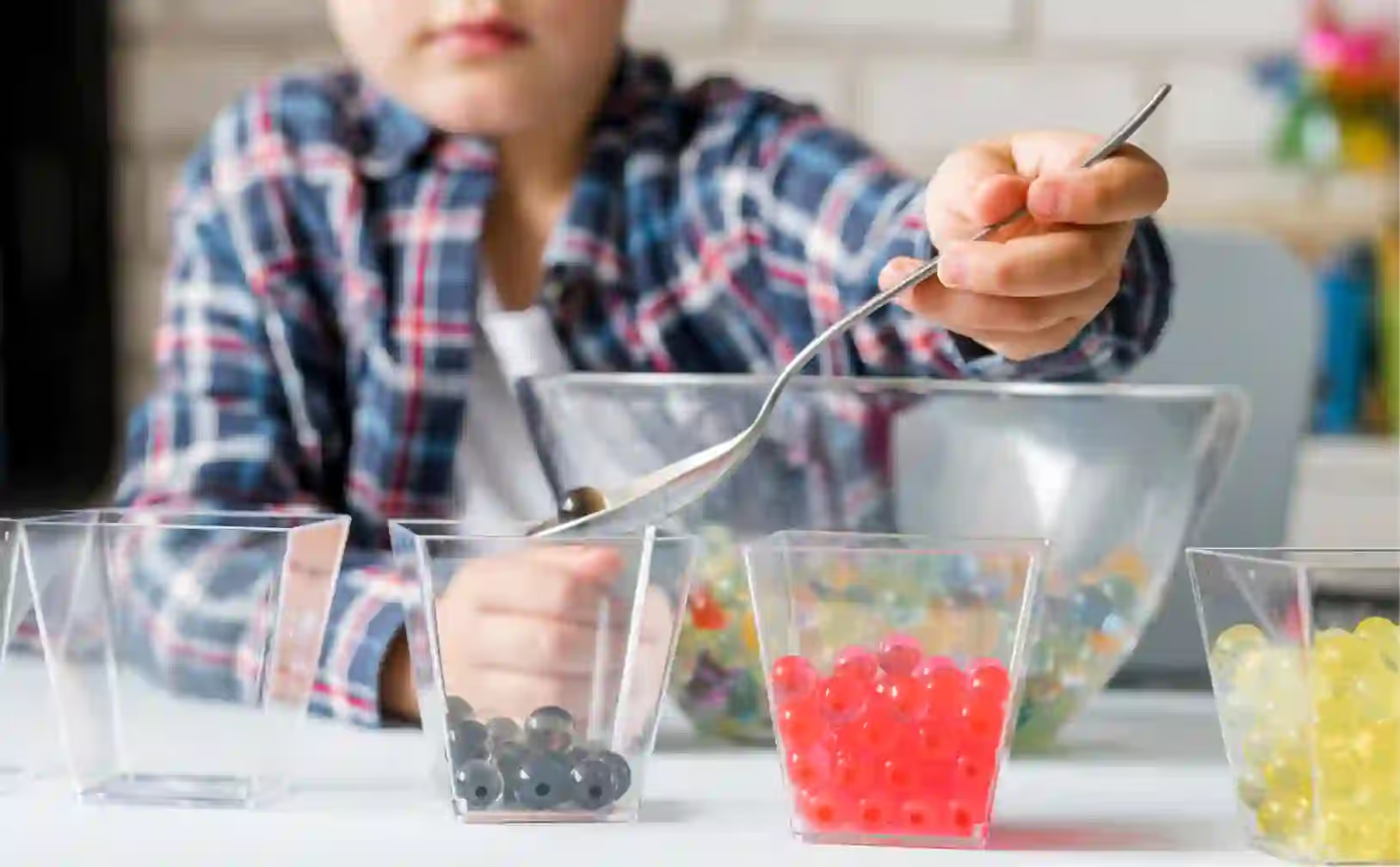
Before we can understand why play matters so much, we need clarity on what "play" actually means in developmental terms. Play isn't just any activity children enjoy—it has specific characteristics that distinguish it from other behaviors.
Developmentally speaking, play is voluntary and intrinsically motivated activity, done for its own sake rather than for external rewards or to meet adult expectations. Play typically involves elements of joy, imagination, and active engagement. Children at play are internally directed rather than externally controlled. They're doing something because they want to, because it interests them, because it feels good—not because an adult demanded it or because they'll receive rewards.
This intrinsic motivation matters enormously because it changes how the brain processes and consolidates learning. When children engage in activities they choose and enjoy, different neurological systems activate compared to when they're complying with external demands. The former supports deep learning, creativity, and genuine skill development. The latter often produces shallow compliance and minimal retention.
Understanding play requires distinguishing several types that serve different developmental functions. Free play describes child-directed, unstructured activity where children determine what to do, how to do it, and for how long without adult direction. This contrasts with structured play, where adults set parameters, rules, or objectives while children engage within those frameworks. Both types serve important purposes, but research from Harvard's Center on the Developing Child emphasizes that free play is irreplaceable for developing autonomy, creativity, and internal motivation.
Social play occurs with others—peers, siblings, or adults—and involves interaction, negotiation, and shared engagement. Solitary play happens alone and serves important functions for concentration, imagination, and working through emotions or ideas independently. Both are developmentally valuable at different times and for different children.
Pretend or sociodramatic play involves imagination and role-taking—playing house, acting out stories, pretending to be animals or characters. This type of play is particularly powerful for developing narrative thinking, emotional processing, and social cognition. Physical play encompasses movement-based activities like running, climbing, rough-and-tumble wrestling, dancing, and active games. This develops motor skills, body awareness, and also supports cognitive development in ways we're only beginning to understand.
Psychologist Mildred Parten identified developmental stages of play that children typically move through, though not always linearly. Unoccupied play in infancy involves apparently random movements as babies learn about their bodies. Solitary play emerges as children engage independently with toys and objects. Onlooker play describes watching others play without joining—important for learning social rules through observation. Parallel play involves playing alongside peers without direct interaction—common in toddlerhood. Associative play includes some interaction and shared materials but without organized activity. Cooperative play, emerging in preschool years, involves playing together toward shared goals with division of roles and negotiation.
Understanding these distinctions helps parents and educators recognize that what looks like aimless activity often represents important developmental work. The toddler absorbed in stacking cups isn't wasting time—they're working on understanding object permanence, cause and effect, and spatial relationships. The preschoolers arguing about who gets to be the princess aren't just being difficult—they're negotiating, compromising, and learning to navigate social hierarchies and conflicts. The kindergartener running in circles isn't avoiding learning—they're regulating their nervous system, developing body awareness, and building the executive function that will help them focus during seated work later.
The concept of "learning through play" has gained recognition globally, with organizations like UNICEF and the LEGO Foundation advocating for playful learning as essential to healthy development and education. This framework recognizes that play isn't separate from or inferior to learning—it's one of the most effective ways young brains acquire skills, process information, and develop competence across all domains.
To understand why play matters so profoundly, we need to look at what's happening inside developing brains during early childhood—and how playful experiences literally build neural architecture.
Early childhood represents a period of explosive brain growth. At birth, a baby's brain contains roughly 100 billion neurons—about as many as they'll ever have. But the magic happens in the connections between neurons, called synapses. During the first three years of life, children form more than 1 million new neural connections every second. By age three, a child's brain has approximately twice as many synapses as an adult brain. This overabundance of connections is then refined through a process called pruning, where frequently used connections strengthen while underused ones are eliminated.
This synaptic development is driven by experience. The brain builds and strengthens neural pathways for abilities the child practices and uses repeatedly while pruning away connections for skills that aren't exercised. Think of it like cross-training for the brain—varied, repeated, engaging experiences build strong, flexible, well-connected neural systems. Play provides exactly this kind of optimal brain-building stimulation because it's intrinsically motivating (encouraging repetition), varied (exercising different systems), and emotionally engaging (supporting memory consolidation).
According to comprehensive research from the American Academy of Pediatrics, play supports brain structure, function, and plasticity in multiple ways. Play stimulates synaptic connections across multiple brain regions simultaneously—integrating sensory, motor, cognitive, and emotional systems in ways that isolated academic instruction rarely does. When a child builds with blocks, they're simultaneously processing visual-spatial information, planning motor movements, predicting outcomes, adjusting strategies based on feedback, and regulating the frustration when structures collapse. This integrated stimulation builds richly connected neural networks rather than isolated skills.
Play also optimizes brain chemistry for learning. Joyful, playful experiences release neurotransmitters including dopamine (supporting motivation and reward processing), serotonin (regulating mood and supporting memory), and endorphins (creating positive associations with learning). These neurochemical conditions support memory consolidation—the brain essentially tags playful learning as important and worth remembering because the emotional context was positive. Conversely, learning under stress or coercion activates cortisol and other stress hormones that can impair memory formation and create negative associations with the learning context.
Executive function—the brain's command and control system—develops powerfully through play. Executive function encompasses three related capacities: working memory (holding information in mind while using it), cognitive flexibility (shifting between different thoughts or strategies), and inhibitory control (suppressing impulses to do what's needed instead). These capacities, which predict school and life success more reliably than IQ, develop through playful experiences that exercise them naturally.
When children play games with rules—Simon Says, Red Light-Green Light, hide and seek—they practice inhibitory control by suppressing impulses and following rules. When they engage in pretend play, they exercise working memory by holding make-believe scenarios in mind while acting them out. When play scenarios go wrong or strategies don't work, they practice cognitive flexibility by adapting and trying new approaches. Research documented by Harvard's Center on the Developing Child shows that these naturally occurring opportunities to practice executive function during play are far more effective than isolated "executive function training" programs.
Stress regulation systems also develop through play. Safe, joyful play with responsive caregivers teaches children that the world can be manageable and that challenges can be fun rather than threatening. This builds resilience and healthy stress response patterns. Play provides opportunities to experience mild challenges—frustration when things don't work, disappointment when you don't win, conflict with playmates—in contexts supportive enough that children can practice managing these feelings without becoming overwhelmed. This graduated exposure to manageable stress during play builds coping capacity that transfers to all of life's challenges.
The concept of "serve and return" interactions, emphasized heavily in Harvard's brain-building research, describes how responsive, back-and-forth engagement between children and caregivers literally builds brain architecture. During playful interactions where adults respond to children's cues, follow their lead, extend their ideas, and maintain warm emotional connection, neural circuits strengthen for language, social cognition, executive function, and emotional regulation. These interactions shape the architecture of the developing brain in ways that more passive learning experiences cannot replicate.
Neuroplasticity—the brain's ability to change and adapt throughout life—is at its peak during early childhood, making this period both a window of enormous opportunity and vulnerability. The experiences children have during these years set trajectories that are possible but much more difficult to change later. This doesn't mean early childhood determines everything, but it does mean that rich, varied, playful experiences during this period build foundations that support all later development.
While adults often focus on whether play teaches specific academic content, play's most powerful effects occur in foundational capacities that support all learning. Understanding what play builds across developmental domains helps recognize its value.
Cognitive and Academic Foundations
Block play represents one of the most researched types of play for cognitive development. When children build with blocks, they're engaging in applied mathematics—exploring spatial relationships, symmetry, balance, patterns, measurement, and early geometry concepts. They learn about relative size, proportion, and the relationship between two-dimensional shapes and three-dimensional structures. Research shows strong correlations between block play in early childhood and later mathematical achievement, particularly spatial reasoning skills that predict success in STEM fields.
Pretend play lays crucial literacy foundations that worksheets cannot replicate. When children engage in dramatic play, they're creating narratives—with characters, settings, problems, and resolutions. This is story structure, the foundation of both reading comprehension and writing. They're using language in decontextualized ways—talking about things not physically present, which is exactly what reading and writing require. They're engaging in symbolic thinking—recognizing that one thing can represent another, which is the fundamental insight needed to understand that marks on paper represent sounds and meanings. According to research on early literacy, children with rich pretend play experiences develop stronger vocabulary, narrative comprehension, and symbolic understanding than peers with limited imaginative play.
Problem-solving develops naturally through play when children encounter challenges and work through them independently. A child trying to make a structure stay up, figuring out how to get a turn with a desired toy, or determining how to reach something high is engaged in authentic problem-solving—identifying the problem, generating possible solutions, testing approaches, and adjusting based on feedback. This cycle of trial, error, adjustment, and persistence builds problem-solving competence that transfers across domains.
Creativity and flexible thinking emerge from play that allows exploration without predetermined correct answers. Unlike academic tasks with right and wrong answers, open-ended play encourages divergent thinking—generating multiple solutions or approaches. A cardboard box becomes a house, a car, a spaceship, a hiding place, a drum—each transformation exercises creative thinking and symbolic flexibility. This creative capacity predicts innovation, adaptability, and complex problem-solving far better than early academic achievement does.
Language and Communication
Language development accelerates during play, particularly social play requiring communication. When children negotiate roles—"You be the doctor and I'll be the patient"—they're practicing complex language including future tense, conditional statements, and role assignment. When they create shared pretend scenarios, they must use language to coordinate actions, explain ideas, and maintain shared understanding. This naturally motivates clear communication in ways that adult-directed language lessons rarely achieve.
Turn-taking in conversation develops through playful back-and-forth exchanges. Games involving conversation—playing restaurant, having tea parties with stuffed animals, creating stories together—teach children the rhythm of dialogue: speaking, listening, responding, waiting. These conversational skills provide foundations for classroom participation, social relationships, and all future communication.
Vocabulary expands dramatically through pretend play as children encounter and use new words in meaningful contexts. Playing veterinarian introduces specialized vocabulary (stethoscope, examination, medicine, diagnosis) that children acquire effortlessly because it's embedded in engaging, memorable experiences rather than presented as abstract definitions to memorize. The emotional engagement and repetition inherent in play support vocabulary retention far better than flashcards or word lists.
Storytelling abilities develop as children create and act out narratives. They learn about story structure, character development, dialogue, and the language of storytelling ("once upon a time," "then," "finally"). These narrative skills directly support both reading comprehension and writing ability when children encounter formal literacy instruction.
Social and Emotional Intelligence
Empathy and perspective-taking develop powerfully through pretend play. When a child pretends to be a parent comforting a crying baby, a teacher helping a struggling student, or a doctor caring for a patient, they're practicing seeing situations from another's viewpoint. They're imagining what others might feel, think, or need. This practice in taking different perspectives builds the cognitive capacity for empathy that underlies all healthy relationships.
Emotional regulation gets practiced constantly during play. Children experience frustration when structures fall or games don't go their way, disappointment when they don't get preferred roles, excitement during active play, and a range of emotions during pretend scenarios. Within the safe context of play, they practice managing these feelings—calming themselves after frustration, tolerating disappointment, modulating excitement. According to research published by the American Academy of Pediatrics, play specifically supports children's ability to plan, organize, get along with others, and regulate emotions—all crucial social-emotional capacities.
Social rules and norms are learned through play that requires negotiating with others. Children discover that grabbing toys leads to conflict while asking leads to cooperation. They learn that listening to others' ideas makes play more enjoyable. They practice fairness, turn-taking, and compromise—all through natural consequences within play rather than adult lectures about proper behavior. The feedback is immediate and meaningful, making these lessons stick far better than abstract instruction about social behavior.
Conflict resolution skills develop as children navigate the inevitable disagreements that arise during play. With supportive adult scaffolding when needed, children learn strategies for resolving conflicts—compromising, finding alternative solutions, articulating their own needs while considering others', and repairing relationships after disagreements. These foundational negotiation skills serve children throughout life in relationships, work, and civic participation.
Physical and Sensory Development
Physical play develops both gross motor skills (running, jumping, climbing, throwing) and fine motor skills (manipulating small objects, drawing, cutting). These motor capacities support academic tasks like writing, using scissors, and manipulating math materials while also building body awareness, coordination, and confidence in physical abilities.
Rough-and-tumble play—wrestling, play-fighting, chasing—which often makes adults nervous, serves important developmental functions. Research shows this type of play supports body awareness, emotional regulation, social boundaries (learning when play becomes too rough), risk assessment, and impulse control. Children learn to modulate their strength, read social cues about when to stop or soften play, and practice self-control while excited and physically engaged.
Sensory-rich play—digging in sand, playing with water, squishing mud, manipulating clay—supports sensory integration, where the nervous system learns to process and respond appropriately to sensory input. These experiences help children develop comfort with various textures, build tolerance for sensory experiences, and practice using sensory information to guide actions. For many children, sensory play is regulating—it calms the nervous system and supports focus. The sensory feedback provides information the brain needs to organize and make sense of the world.
Balance and vestibular system development occurs through spinning, swinging, rolling, and other movement activities. The vestibular system processes information about movement and spatial orientation and is foundational for attention, coordination, and spatial awareness. Children naturally seek the vestibular input they need through play—spinning until dizzy, swinging high, rolling down hills—activities that support this crucial sensory system's development.
Understanding specific play types helps parents and educators recognize and support the full range of developmentally valuable play experiences.
Free play describes child-directed, unstructured time where children determine what to do without adult planning, direction, or predetermined outcomes. This is play in its purest form—intrinsically motivated, open-ended, following children's interests and curiosity.
Research on free play consistently demonstrates its irreplaceable role in developing creativity, problem-solving, intrinsic motivation, and independence. When children direct their own play, they practice decision-making, experience genuine agency, discover their own interests, and develop internal motivation—the drive to do things because you want to rather than for external rewards. These capacities predict long-term success far better than early academic achievement.
Free play also allows children to work through emotions, ideas, and experiences at their own pace. A child who's anxious about an upcoming doctor visit might play doctor repeatedly, processing their anxiety through pretend. A child struggling with friendship conflicts might act out scenarios with dolls, working through social challenges safely. This self-directed emotional processing supports psychological health in ways adult-structured activities cannot replicate.
The decline of free play in modern childhood, documented extensively in developmental literature, correlates with increases in childhood anxiety, depression, and sense of helplessness. When children's time is constantly structured by adults, they miss opportunities to develop autonomy, discover their own interests, practice entertaining themselves, and build confidence in their own judgment. Protecting time for genuinely free, unstructured play is one of the most important things parents and educators can do for children's healthy development.
Guided play occupies the space between totally free play and direct instruction. Adults set up environments, provide materials, or pose challenges that support learning goals, but children lead the exploration and discovery. This approach combines the motivational and cognitive benefits of child-directed activity with the scaffolding that helps children extend beyond what they'd discover alone.
Research shows guided play can be optimal for certain types of learning. For example, a teacher might provide materials for exploring sinking and floating, pose questions to extend thinking, and participate in children's investigations, but children choose how to explore, what to test, and how long to engage. This maintains intrinsic motivation while supporting deeper learning than entirely independent exploration might achieve.
Guided play works by respecting children's natural curiosity while providing just enough structure to support progress toward learning goals. The adult might introduce a new material, ask an open-ended question, model a possibility, or offer a challenge—then step back and let children explore. This approach develops self-directed learning skills while ensuring children encounter content and concepts adults want them to explore.
The key to effective guided play is maintaining child agency and choice. If adult guidance becomes so directive that children are essentially following instructions, the motivational and cognitive benefits diminish. The skill is providing enough scaffolding to support exploration without taking over the investigation.
Pretend play, particularly sociodramatic play involving multiple children creating shared imaginary scenarios, might be the most cognitively complex activity young children naturally engage in. When children play school, family, veterinarian, or create elaborate fantasy worlds, they're exercising multiple cognitive systems simultaneously in ways few other activities require.
Playing these scenarios requires:
All of this represents sophisticated cognitive work that directly supports academic learning. The narrative thinking developed through pretend play transfers to reading comprehension and writing. The symbolic thinking translates to understanding mathematical symbols and abstract concepts. The planning and organization support executive function development.
Pretend play also serves crucial emotional functions. Children rehearse experiences they've had or anticipate having—visits to doctors, starting school, dealing with siblings, managing scary situations. Through pretend, they gain sense of mastery over experiences that might otherwise feel overwhelming. They process emotions safely within the play frame. They try out different responses and see how scenarios might unfold.
Sociodramatic play specifically teaches social skills that isolated children or direct social skills instruction cannot match. Children negotiating shared pretend scenarios must communicate clearly, listen to others' ideas, compromise, take turns with leadership, and adapt when things don't go as planned. These are precisely the social competencies that predict success in school, work, and relationships.
Physical play—running, climbing, jumping, dancing, playing chase games, rough-housing—serves functions far beyond physical fitness, though that alone would justify prioritizing it. Research increasingly shows that physical activity supports cognitive development, executive function, attention, and mood regulation in profound ways.
Movement activates the cerebellum, a brain region once thought to only coordinate physical movement but now understood to play crucial roles in executive function, attention, and learning. Physical play literally increases blood flow to the brain, supporting neural function and growth. It regulates neurotransmitters including dopamine and serotonin that affect mood, motivation, and attention.
Children who engage in regular physical play show better attention, improved executive function, reduced behavioral problems, and better academic performance compared to more sedentary peers. The relationship appears causal—experimental studies where children are assigned to more physically active routines show improvements in cognitive function, not just correlations.
Physical play also teaches children about their bodies' capabilities, builds confidence in physical competencies, supports healthy risk-taking (learning to calibrate challenges to abilities), and provides essential stress relief. Children naturally seek the physical activity their nervous systems need—watching a group of kindergarteners reveals constant movement not because they're misbehaving but because their developing brains need movement input.
The decline in physical play—due to reduced recess, eliminated outdoor time, safety concerns about active play, and increasing screen time—has serious implications for children's cognitive, emotional, and physical development. Prioritizing substantial daily physical play isn't optional for healthy development; it's essential.
Modern play increasingly includes digital components, requiring thoughtful navigation of technologies that didn't exist in previous generations. While screens deserve appropriate limits and oversight, emerging research on what's called "physical-digital play" suggests that certain digital tools can enhance rather than replace valuable play when thoughtfully integrated.
Interactive educational apps that respond to children's choices, coding platforms where children build programs that do things, augmented reality tools that overlay digital information on physical environments, and robots children can program all represent "physical-digital play"—combining screen elements with physical interaction and genuine problem-solving. Research on these technologies suggests they can support learning when they maintain playful elements, encourage active engagement rather than passive consumption, involve physical manipulation alongside digital components, and support rather than replace social interaction.
The key distinctions are:
Digital play that's interactive, social, physically engaged, and open-ended can support development. Digital entertainment that's passive, isolated, sedentary, and predetermined often displaces valuable offline play without providing compensating benefits. The challenge for parents and educators is distinguishing between these types and setting appropriate boundaries and guidelines around each.
Perhaps no question produces more parental anxiety than whether play-based approaches will leave children behind academically. The cultural pressure toward earlier and more intensive academics is powerful, making it crucial to understand what research actually shows about academic outcomes.
Multiple studies tracking children over time show a pattern: children in play-based early childhood programs often score lower initially on academic assessments compared to peers in academic-focused programs. By first or second grade, these differences disappear—the play-based children catch up quickly once formal academic instruction begins. By third or fourth grade, patterns often reverse—children from play-based backgrounds show equal or superior academic achievement alongside better social-emotional skills, more engagement in learning, and stronger executive function.
Perhaps more importantly, long-term studies finding to adolescence and adulthood show that early academic advantage often doesn't persist. Children pushed into academics early rarely maintain advantages over peers who started later but with stronger play foundations. Conversely, early academic pressure can create lasting negative effects including anxiety about school, reduced intrinsic motivation for learning, and weaker self-directed learning skills. The research suggests we're often trading long-term outcomes for short-term appearance of advancement.
Work from researchers at Harvard and other institutions examining play-based versus academic-focused early childhood approaches finds that play-based curricula better support:
Meanwhile, academic-focused approaches show:
The pattern suggests that play builds the foundations that support all later learning, while premature academics might produce test score gains without building underlying capacities. It's the difference between building a house starting with a strong foundation versus starting with the roof—the latter might look more impressive initially but won't support long-term success.
Importantly, play-based doesn't mean anti-academic. High-quality play-based programs intentionally support early literacy, mathematical thinking, and scientific reasoning through playful exploration rather than direct instruction. When adults thoughtfully support play with materials, questions, and scaffolding that extend learning, children encounter genuine academic content in developmentally appropriate, engaging contexts. The five-year-old building with blocks is learning geometry, patterns, and spatial relationships—they're doing mathematics, just not through worksheets. The children playing veterinary clinic are developing vocabulary, narrative skills, and scientific observation—they're learning literacy and science through play.
The key insight is that young children learn best through active, meaningful, engaging experiences—which play provides naturally—rather than through isolated skills instruction removed from meaningful context. Academic skills taught in playful contexts tend to stick better, transfer more readily, and maintain intrinsic motivation more effectively than skills taught through rote instruction.
Parents worried about kindergarten readiness should know that the best predictors of school success aren't academic skills like letter recognition or counting—they're social-emotional capacities like following directions, managing frustration, paying attention, getting along with peers, and sustaining engagement with challenging tasks. All of these develop powerfully through play. A child who can't yet read but has strong executive function, emotional regulation, and social skills will thrive in kindergarten. A child who knows letters and numbers but struggles with attention, emotional regulation, or social interaction will struggle regardless of academic knowledge.
Executive function deserves special attention because it's both crucial for all learning and uniquely well-developed through play.
Executive function encompasses the mental processes that allow us to plan, focus attention, remember and follow instructions, juggle multiple tasks, and regulate emotions and impulses. Think of it as the brain's air traffic control system—managing incoming information, directing attention, coordinating responses, and ensuring everything works together effectively.
Three core executive function capacities emerge during early childhood and continue developing through adolescence:
Research from Harvard's Center on the Developing Child shows that executive function predicts school readiness and academic achievement more reliably than IQ or early academic skills. Children with strong executive function can focus during instruction, follow directions, manage frustration when work is hard, and regulate behavior appropriately. Children with weak executive function struggle even if they're intellectually capable and academically knowledgeable.
The beautiful efficiency is that play naturally exercises executive function without requiring special programs or expensive interventions. Traditional children's games humans have played for generations—hide and seek, tag, board games, card games, pretend play, building activities—all naturally practice these capacities in ways that are engaging, intrinsically motivating, and developmentally appropriate.
The key is providing adequate time for these activities and recognizing their developmental value. When schools eliminate recess to add instructional time or when family schedules become so packed that free play disappears, children lose crucial opportunities to develop executive function. Ironically, the extra instructional time is often ineffective precisely because children haven't developed the executive function capacities that allow them to benefit from instruction.
Self-regulation—the broader capacity to manage emotions, behavior, attention, and impulses—develops alongside and through executive function. Play provides countless naturally occurring opportunities to practice self-regulation: managing disappointment when you don't get the role you wanted, controlling excitement during active play, focusing attention during building projects, negotiating conflicts with playmates, and persisting through challenges.
Children can't learn self-regulation through lectures about behavior—they must practice it repeatedly in contexts meaningful to them. Play provides exactly this practice in ways that feel good rather than punitive, making the learning stick far better than external behavior management systems imposed by adults.
Understanding play's role in stress regulation and resilience reveals why play isn't optional for healthy development but rather essential for emotional health.
Toxic stress—chronic activation of stress response systems without adequate buffering from supportive relationships—alters developing brain architecture in harmful ways. Research extensively documents that toxic stress during childhood increases risk for virtually all negative outcomes: academic struggles, mental health problems, physical health issues, relationship difficulties, and reduced life expectancy. Conversely, resilience—the capacity to cope effectively with challenges and bounce back from adversity—protects against these negative outcomes even when stressors are present.
Research on adverse childhood experiences (ACEs) shows that while trauma and chronic stress do damage development, protective factors dramatically moderate these effects. The most powerful protective factors are supportive relationships and opportunities to develop coping skills—both of which play provides naturally. Children with access to play, particularly with caring adults and peers, show better outcomes even in face of significant adversity compared to children facing similar adversity without adequate play opportunities.
Play deprivation, conversely, can function as its own form of stress. Children need play—their brains and bodies are designed to learn, regulate, and develop through play. When play is consistently denied or minimized, children may show stress symptoms including behavioral problems, emotional dysregulation, anxiety, reduced frustration tolerance, and difficulty managing age-appropriate challenges. What adults might perceive as misbehavior or weakness is often the predictable result of insufficient opportunity for the stress relief and regulation that play naturally provides.
Supporting children's resilience isn't about eliminating all challenges or stress—some manageable stress is necessary and healthy for building coping capacity. It's about ensuring children have the relationships, experiences, and skills to cope effectively with the challenges they encounter. Play provides exactly this practice in coping, along with the relationships and positive experiences that buffer stress and build resilience.
Understanding play's importance is valuable only if translated into actual changes in home environments and family routines.
Creating play-rich homes doesn't require large spaces or expensive toys. The essential elements are time protected for play, materials that invite open-ended exploration, and adults who value and support play rather than viewing it as time-filler between more important activities.
In any home, start by evaluating how materials are organized and accessible. Store toys and play materials where children can see and reach them independently—low shelves beat closed cabinets, clear bins beat opaque ones. Rotate materials periodically to maintain novelty without requiring constant purchases. Group items logically: art supplies together, building materials in another area, dramatic play props accessible. This organization supports independence and sustained engagement because children can find and return materials without adult help.
The living room can become play space with minimal designated materials. A basket of dress-up clothes, some scarves or fabric pieces, and a few open-ended props (dolls, stuffed animals, play dishes) support pretend play. A basket of quality building materials—wooden blocks, LEGO, or Magna-Tiles—provides for construction play. Floor space for building and playing matters more than furniture.
Kitchens offer rich play opportunities through real participation in cooking, baking, measuring, and pouring. Let children wash vegetables, stir ingredients, measure and pour, crack eggs (with patience for messes), and participate in real work that also teaches mathematics, following sequences, observation, and builds competence. Provide access to safe containers, measuring cups, and water for independent sink play. Save interesting containers, lids, and safe kitchen items for exploration.
Bedrooms can include cozy reading nooks with good lighting and comfortable seating, small-world play setups (toy animals or figures with blocks or natural materials creating scenes), and space for projects that can be left in progress. Resist filling bedrooms with electronics and stimulating entertainment—these are spaces for rest, imagination, and quiet play.
For families in small spaces, play happens in creative ways. A tablecloth over a table creates a fort. A corner behind a chair becomes a cozy hideout. A basket of materials moves to wherever space exists at the moment. Vertical organization (wall-mounted or hanging storage) saves floor space. Many activities move outdoors to porches, stoops, yards, or parks when indoor space is limited.
Outdoor spaces invite the physical, sensory play that's most difficult indoors. Even small outdoor areas can provide digging opportunities, water play, running space, and connection with natural materials. For families without yards, regular park visits, carrying sidewalk chalk or balls to empty parking lots, and treating outdoor time as essential rather than optional makes outdoor play accessible.
The single most important element isn't materials but time. Children need substantial chunks of unstructured time—ideally at least an hour daily—where they're free from screens, scheduled activities, homework, and adult direction. This might mean protecting after-school time from filling with activities, limiting screen time to create space for play, or ensuring weekends include extended unstructured play time rather than being packed with structured activities.
Open-ended materials—items that can be used in many ways without predetermined outcomes—provide more play value than single-purpose toys. Blocks, clay, art materials, cardboard boxes, fabric scraps, natural objects (sticks, stones, shells, pinecones), and dress-up clothes all support endless variations of play. These materials often cost less than expensive branded toys while providing richer play experiences because children can use them in whatever ways imagination suggests.
Creating a play-rich home is less about what you buy and more about what you prioritize. Time for play, materials that invite creativity, space for mess and projects, and adults who value play enough to protect it—these matter more than elaborate play rooms or expensive toys. The goal is removing obstacles to play (constant screens, over-scheduling, inadequate materials, constant interruption) rather than creating perfect play environments.
Play in 2025 inevitably includes digital dimensions, requiring thoughtful navigation of technology's role in play rather than either wholesale embrace or rejection.
The key distinction is between passive screen time (watching videos, playing games designed primarily for entertainment) and interactive, creative digital play where screens are tools supporting genuine play rather than replacing it. Coding platforms where children build programs, digital art or music creation tools, stop-motion animation apps where children create stories, and augmented reality tools that overlay digital information on physical environments all represent screens supporting creative play rather than passive consumption.
Emerging research on what researchers call "physical-digital play"—activities combining physical materials with digital elements—suggests potential benefits when technology enhances rather than replaces hands-on exploration. For instance, apps that identify plants or stars encourage outdoor exploration while providing information. Tablets used to photograph and document block structures or art projects support reflection and documentation. Robots that children can program combine physical building and movement with coding logic.
The challenge is that most children's screen time isn't these thoughtful hybrid activities but rather passive consumption of entertainment or engagement with games designed to maximize screen time through addictive reward loops. Following American Academy of Pediatrics guidance, families should:
For young children specifically, the AAP recommends minimal screen time for children under two years (except video chatting with family), limited high-quality co-viewed programming for preschoolers, and thoughtful limits continuing through elementary years. The emphasis is on quality over quantity—30 minutes of high-quality, co-engaged, interactive screen time provides far more value than hours of passive viewing.
When screens do enter play, the questions to ask are: Is this supporting my child's creativity, problem-solving, and exploration, or just entertaining them? Is screen time balanced with substantial offline play, physical activity, and social interaction? Are screens replacing the hands-on, sensory, physically active play that young children need? Am I modeling healthy screen use, or constantly on devices while expecting my child to limit theirs?
The goal isn't eliminating technology from childhood—digital literacy matters for the future, and well-chosen digital tools can genuinely enhance learning. The goal is ensuring technology serves play and learning rather than dominating or replacing the hands-on, physical, social experiences that remain foundational for young children's healthy development.
The preschooler building that chaotic block tower at the start of this article isn't doing something separate from learning—they're engaged in learning's most powerful and natural form. The brain-building happening during play is more sophisticated, more integrated, and more developmentally appropriate than what happens during most adult-directed academic instruction could ever achieve.
Play is not the opposite of learning. Play is how young children's brains are designed to learn—through active, meaningful, engaging, intrinsically motivated exploration of the physical, social, and imaginative worlds. The neurological evidence is clear: play builds neural architecture, exercises executive function, regulates stress, supports social-emotional development, and establishes foundations for all later learning in ways that premature academic instruction cannot replicate.
The uncomfortable reality is that our culture increasingly treats play as luxury or distraction rather than essential childhood experience. We've convinced ourselves that earlier is better, that measurable academic progress matters more than foundational capacities, that more structure and instruction produce better outcomes. Decades of research say otherwise. Children with rich play experiences develop into students, workers, and adults with stronger executive function, better social-emotional health, more creativity, greater resilience, and ultimately, comparable or superior academic achievement compared to peers pushed into academics early.
Protecting play requires courage because it means resisting cultural pressure toward more academics, more structure, more measurable productivity. It means trusting that the five-year-old lost in pretend play is building literacy foundations more effectively than the five-year-old drilling sight words. It means believing that the child climbing trees and digging in mud is developing executive function and risk assessment better than the child doing educational apps. It means prioritizing the invisible work of brain-building through play over the visible appearance of academic progress through early instruction.
You don't need expensive materials, elaborate play spaces, or expert knowledge. You need time protected from intrusion, materials that invite creativity, and recognition that play is the real work of childhood. You need to trust children's natural drive to play, learn, and grow when given appropriate support and freedom.
The best "curriculum" for young children might look, from the outside, suspiciously like a child completely absorbed in joyful play—building, pretending, exploring, creating, moving, imagining, negotiating with friends, and discovering the world through the activity evolution designed for exactly this purpose. That is learning. That is brain-building. That is precisely what children need to develop into capable, resilient, creative, compassionate humans.
Protect play. Prioritize play. Trust play. Your child's developing brain knows what it needs—and what it needs is time to play.
Related posts
Mixing languages isn’t confusion—it’s progress. Discover why bilingual toddlers may talk differently, but not late, and how to support healthy speech development.
Discover how left-handed children experience learning differently, why handwriting and classroom tools can create unnecessary frustration, and which simple accommodations turn daily struggles into confidence.
Worried your 4-year-old still can’t name letters? Learn what’s truly normal for letter recognition, when to relax, when to seek help, and how to gently support learning.
Learn how to recognize a highly sensitive preschooler, avoid misdiagnosis, and adapt nursery and home environments so your child feels safe, understood, and able to thrive.
Worried your toddler isn’t talking yet? This guide explains the difference between “late talker” and speech delay, key red flags, when to seek an evaluation, and how to support language at home.