

Using AI Tools Safely to Support Homework: A Parent’s Guide
AI is already part of homework. Learn how to help your child use tools like ChatGPT safely and effectively—supporting learning, not replacing it.
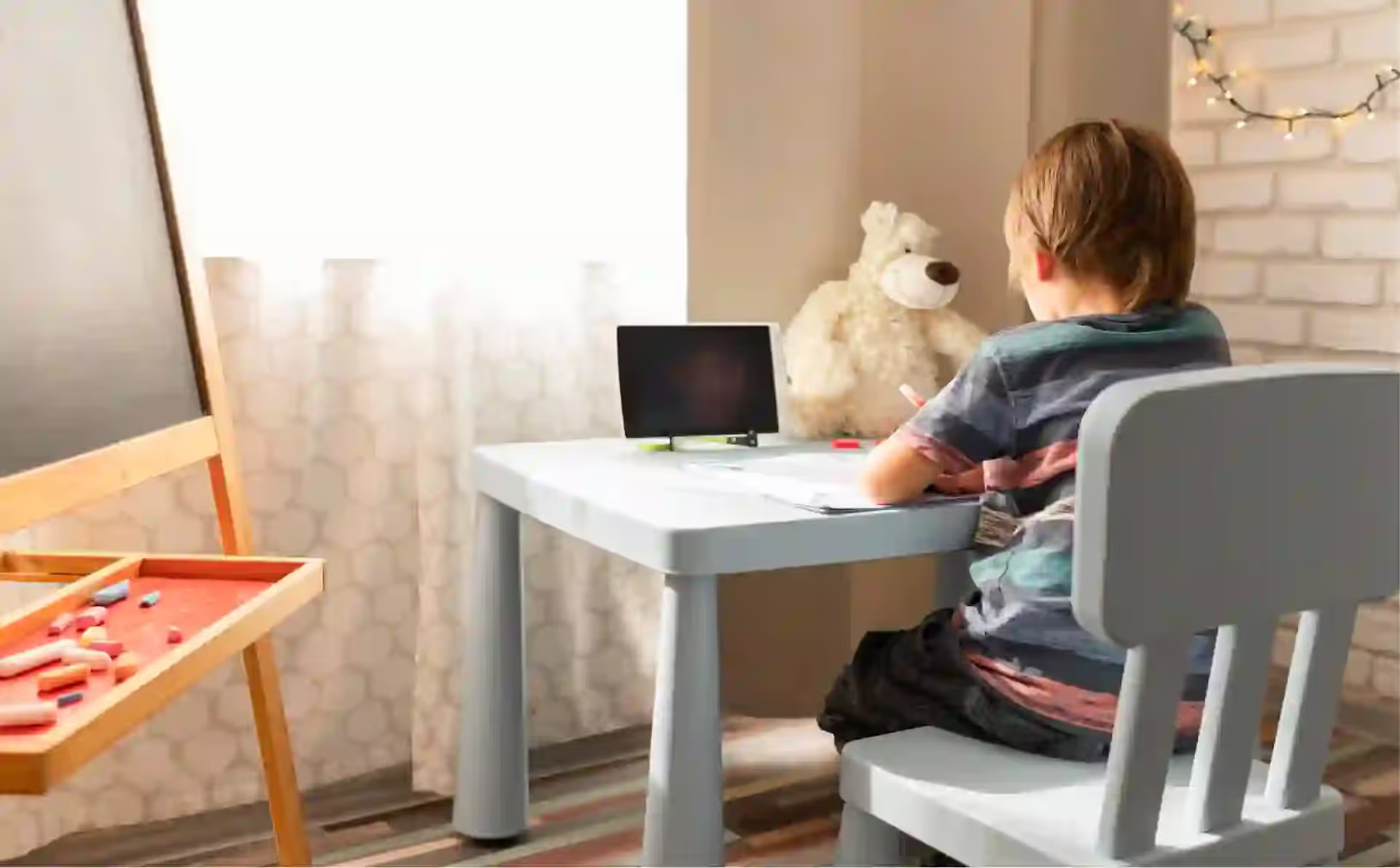
Here's a radical thought: what if the best learning happens when your child isn't hunched over worksheets at the kitchen table, tears streaming down their face because they don't understand long division?
The nightly homework battle has become so normalized in American family life that we've forgotten to ask whether it's actually necessary. The scene plays out in millions of homes: a tired child arrives home after seven hours at school, faces another hour or two of assignments, and everyone ends up frustrated. Parents become enforcers rather than supporters. Children learn to associate learning with stress. Family time evaporates into arguments about incomplete math problems.
But there's another way. A growing number of families are discovering that learning without traditional homework doesn't mean learning less—it often means learning more, and learning better. These families are creating homework-free learning spaces at home: environments designed to spark curiosity, encourage exploration, and develop skills through authentic engagement rather than mandatory assignments.
This isn't about abandoning education or lowering standards. It's about recognizing that the brain learns most effectively through intrinsic motivation, meaningful context, and genuine interest—none of which are reliably produced by worksheets. Educational movements worldwide, from Finland's play-based approach to project-based learning models gaining traction across innovative American schools, demonstrate that there are powerful alternatives to the homework grind.
This guide will show you how to create a home learning environment that nurtures academic growth, builds critical thinking skills, and develops a genuine love of learning—without the tears, without the battles, and without traditional homework.
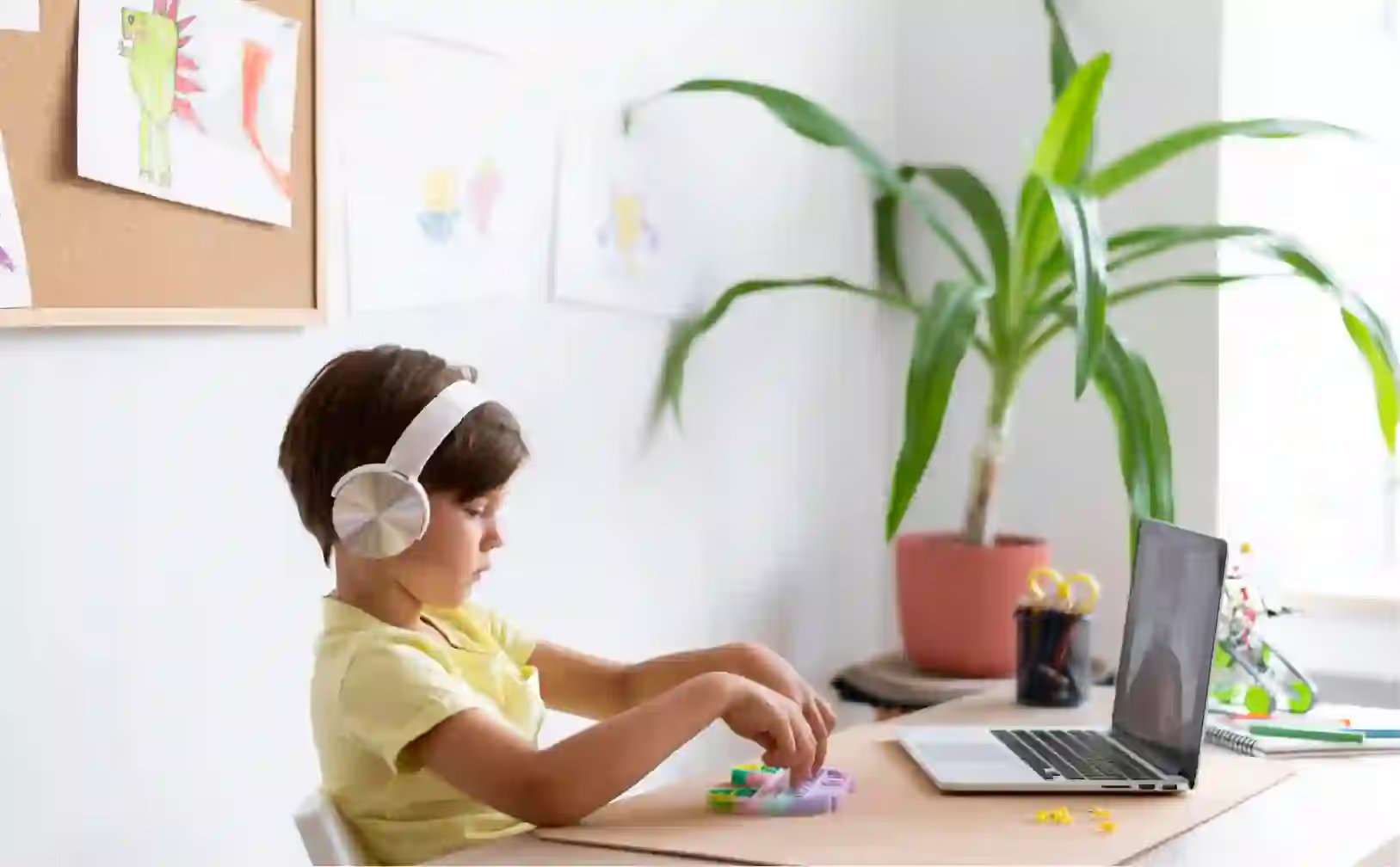
Before we explore alternatives, let's examine why homework—especially for elementary-age children—deserves serious questioning.
Research conducted by Harris Cooper at Duke University, summarizing decades of studies, reveals something most parents find shocking: homework provides little to no academic benefit for elementary school students. Cooper's comprehensive analysis found virtually no correlation between homework and achievement for children in grades K-6. The benefits that do emerge appear only in middle and high school, and even then, they plateau quickly—more than two hours of homework per night shows no additional academic gains even for teenagers.
Think about that for a moment. The activity consuming your evenings, straining your relationship with your child, and causing genuine distress may be contributing essentially nothing to their academic development. The tears and battles aren't a necessary price for educational success—they're just waste.
Beyond the lack of academic benefit, traditional homework creates significant emotional and developmental costs. Young children need unstructured play time for cognitive development, physical activity for health and emotional regulation, family connection time for secure attachment, and adequate sleep for memory consolidation and growth. Homework systematically erodes all of these. A first-grader finishing homework at 6pm has missed the window for outdoor play, arrives at dinner stressed rather than relaxed, and may sacrifice sleep to complete assignments that contribute nothing measurable to their education.
The homework burden also creates family strain that rarely gets discussed in educational policy. Parents become homework enforcers, a role that damages the parent-child relationship. Many parents work full days themselves and lack the energy or subject knowledge to effectively support homework. Families with multiple children face logistical nightmares coordinating different homework demands. Single parents and working parents face impossible choices between career demands and homework supervision. The assumption that all families have the resources, time, and expertise to support nightly homework reflects profound socioeconomic blindness.
Perhaps most damaging is what homework teaches children about learning itself. When learning is presented as mandatory, externally imposed, and disconnected from authentic interest or application, children internalize that learning is something done to you rather than something you do for yourself. They learn to associate education with compliance rather than curiosity, with obligation rather than discovery. This fundamentally undermines intrinsic motivation—the very quality that predicts long-term educational success and lifelong learning far better than any homework completion rate.
The "more is better" fallacy pervades American academic culture despite overwhelming evidence that more homework doesn't produce better outcomes and often produces worse ones. We've created a system where quantity substitutes for quality, where the appearance of rigor (stacks of worksheets) replaces actual rigor (deep engagement with meaningful challenges). Parents and educators often defend homework not because evidence supports its effectiveness but because it feels like we're doing something, like we're taking education seriously. But serious education and serious learning look very different from piles of worksheets.
Understanding why homework-free learning can be more effective requires understanding how the brain actually learns.
Research from Harvard University's Center on the Developing Child demonstrates that intrinsic motivation—doing something because it's inherently interesting or satisfying—produces dramatically different neurological responses than extrinsic motivation (doing something to avoid punishment or receive rewards). When children engage in intrinsically motivated learning, their brains show increased activity in regions associated with attention, memory consolidation, and creative problem-solving. They enter flow states where learning happens almost effortlessly because the brain is optimally engaged.
Traditional homework, by its nature, relies almost entirely on extrinsic motivation. Children complete it because they must, because they'll face consequences if they don't, because adults demand it. This activates stress and compliance systems in the brain rather than curiosity and engagement systems. The learning that occurs under these conditions is typically shallow—sufficient to pass a test but rarely integrated into long-term understanding or connected to broader knowledge frameworks.
Contrast this with a child who decides to learn about volcanoes because they're fascinating, who researches how bridges stay up because they're genuinely curious, or who practices multiplication because they need it to solve a problem they care about. The neurological engagement is completely different. Information acquired through intrinsic interest gets processed more deeply, retained more effectively, and integrated more thoroughly with existing knowledge. This is the kind of learning that lasts, that transfers to new situations, that builds genuine competence rather than test-passing ability.
Informal learning—the kind that happens outside formal instruction and assignments—accounts for an enormous proportion of what children actually know and can do. Think about how children learn to navigate video games, master sports skills, or become experts on topics they're passionate about. Nobody assigns homework on Minecraft strategies, yet millions of children develop sophisticated spatial reasoning, resource management, and creative problem-solving through gameplay. Nobody forces baseball card memorization, yet children develop categorization skills, statistical reasoning, and information recall that would impress any educator. The learning happens naturally, powerfully, and joyfully because it's self-directed and meaningful.
Independent play, which homework systematically reduces by consuming after-school hours, serves as one of the most powerful catalysts for cognitive development. During unstructured play, children practice executive function skills: planning, problem-solving, working memory, cognitive flexibility, and self-regulation. They engage in metacognition—thinking about their thinking. They experiment with cause and effect, test hypotheses, and develop scientific reasoning. All of this happens naturally through play that looks to adults like "just fooling around" but is actually the brain's preferred method for learning about the world.
The homework-free model works because it protects time and energy for the kinds of learning that actually develop competent, curious, capable children. Instead of depleting motivation and time through mandatory assignments, it leverages natural curiosity, provides meaningful context, and allows learning to emerge from authentic engagement with interesting challenges.
What makes a space conducive to self-directed learning? It's not about recreating a classroom at home or about expensive equipment. The most effective home learning environments share several key characteristics that work together to invite exploration and support sustained engagement.
Now we get to the heart of the matter: if traditional homework isn't happening, what is?
Project-based learning brings academic skills into meaningful context. Instead of worksheets practicing reading comprehension through random short passages, a child researches a topic they're curious about—maybe dinosaurs, or medieval castles, or how electricity works—and creates something with that knowledge. They're reading, processing information, organizing thoughts, and communicating understanding, but the motivation is internal and the learning is integrated. Projects can be short (a poster about favorite animals) or extended (building a model solar system over several weeks). The key is that children choose topics that interest them and that the project requires actually doing something with the information rather than just consuming it.
Real-life math embedding mathematical thinking into daily activities proves far more effective than decontextualized worksheets. Cooking requires fraction understanding, measurement, timing, and sometimes scaling recipes up or down—all meaningful math applications. Grocery budget planning develops estimation, addition, comparison, and decision-making. Planning a garden involves measurement, geometry (spacing and layout), multiplication (calculating seeds needed), and prediction (time to harvest). Building projects require precise measurement, calculation, and spatial reasoning. When children see why math matters and how it helps them accomplish real goals, the learning sticks in ways that worksheet drill never achieves.
"Read and explain" evenings transform reading from an assignment into a shared experience. Instead of requiring a child to read alone and answer comprehension questions, read together (taking turns or with parents reading more complex texts) and then talk about what you read. Ask genuine questions—not the testing-comprehension kind but real wondering: "Why do you think the character did that? What would you have done differently? How do you think she felt when that happened?" This develops critical thinking, empathy, inference, and genuine comprehension far more effectively than workbook questions. For children resistant to reading, being read to still develops vocabulary, narrative structure understanding, and all the cognitive benefits of stories—reading to them isn't cheating, it's developmentally appropriate scaffolding.
Curiosity-driven challenges leverage children's natural desire to figure things out. Pose open-ended problems: "I wonder if you could build a bridge across the hallway using only newspaper and tape—how would you do that?" "Could you figure out how much it costs to run our refrigerator for a month?" "What's the fastest way to get water to boil—does the container shape matter?" These challenges are inherently motivating because they're real puzzles, not artificial exercises. Children develop hypothesis testing, experimental design, persistence through failure, and genuine problem-solving—skills infinitely more valuable than the ability to complete worksheets quickly.
Teaching-back might be the single most powerful learning strategy available. Have your child teach you something they're learning about—explain how photosynthesis works, teach you a card game strategy, describe the process of butterfly metamorphosis. The act of teaching forces organization of knowledge, identification of key concepts, and metacognition about their own understanding. When children can teach something clearly, they truly know it. This works for any subject and any age—even young children can explain their understanding through demonstration or simple language.
These strategies work because they're not trying to replicate school at home. They're recognizing that real learning looks different from schoolwork and that authentic engagement with meaningful challenges develops competence in ways that homework never could.
One of the most damaging myths in American education is that play is only for young children and that school-age kids need to buckle down and get serious. The research, particularly from the American Academy of Pediatrics, is unequivocal: play remains essential for development throughout childhood and even into adolescence.
The key insight is that play isn't the opposite of learning—it's the primary mechanism through which children learn most naturally and effectively. Protecting time for play isn't sacrificing education; it's prioritizing the kind of learning that actually matters.
Not all learning needs to be extended projects or play. Sometimes focused, brief engagement with specific skills serves important purposes, but the key is keeping it short, engaging, and purposeful.
Ten-minute knowledge bursts recognize attention span realities and prevent the fatigue that comes from extended homework sessions. A child might spend ten minutes learning about a new topic through a documentary clip, practicing mental math through a quick game, or exploring a new vocabulary word family. The brevity prevents resistance and maintains engagement. Multiple short sessions typically produce better learning than one long session anyway—the brain consolidates information better with spacing between exposures.
The teaching-back method works beautifully in microlearning format. "You have ten minutes to become an expert on how volcanoes form, and then you're going to teach me." This time pressure adds engaging challenge, focuses attention, and ensures brevity. When children know they'll be teaching something, they pay attention differently—more actively, more critically, more organizationally. This simple structure transforms passive consumption into active learning.
Educational technology, when used thoughtfully, offers powerful microlearning opportunities. Khan Academy provides short, focused lessons on specific concepts with immediate practice opportunities. Duolingo teaches languages through game-like brief sessions. Educational YouTube channels explain concepts in entertaining, focused ways. The key is selectivity and intentionality—choose high-quality content, keep sessions brief, and prioritize interactive or creative use over passive consumption. Technology works best as a tool children use to learn rather than a device that entertains while claiming to educate.
Knowledge-based challenges maintain novelty and engagement. Each day might include a different micro-challenge: "Find three things in our house that demonstrate the concept of friction," "Explain why ice floats using what you know about density," "Calculate how many days until your birthday and how many hours that is." These challenges take minutes, develop specific skills or knowledge, and maintain an element of fun that prevents the resistance traditional homework generates.
The goal of microlearning isn't to replicate homework in shorter sessions—it's to recognize that focused, intentional engagement with specific content can be valuable when it's brief enough to maintain attention and interesting enough to feel more like a game than an assignment.
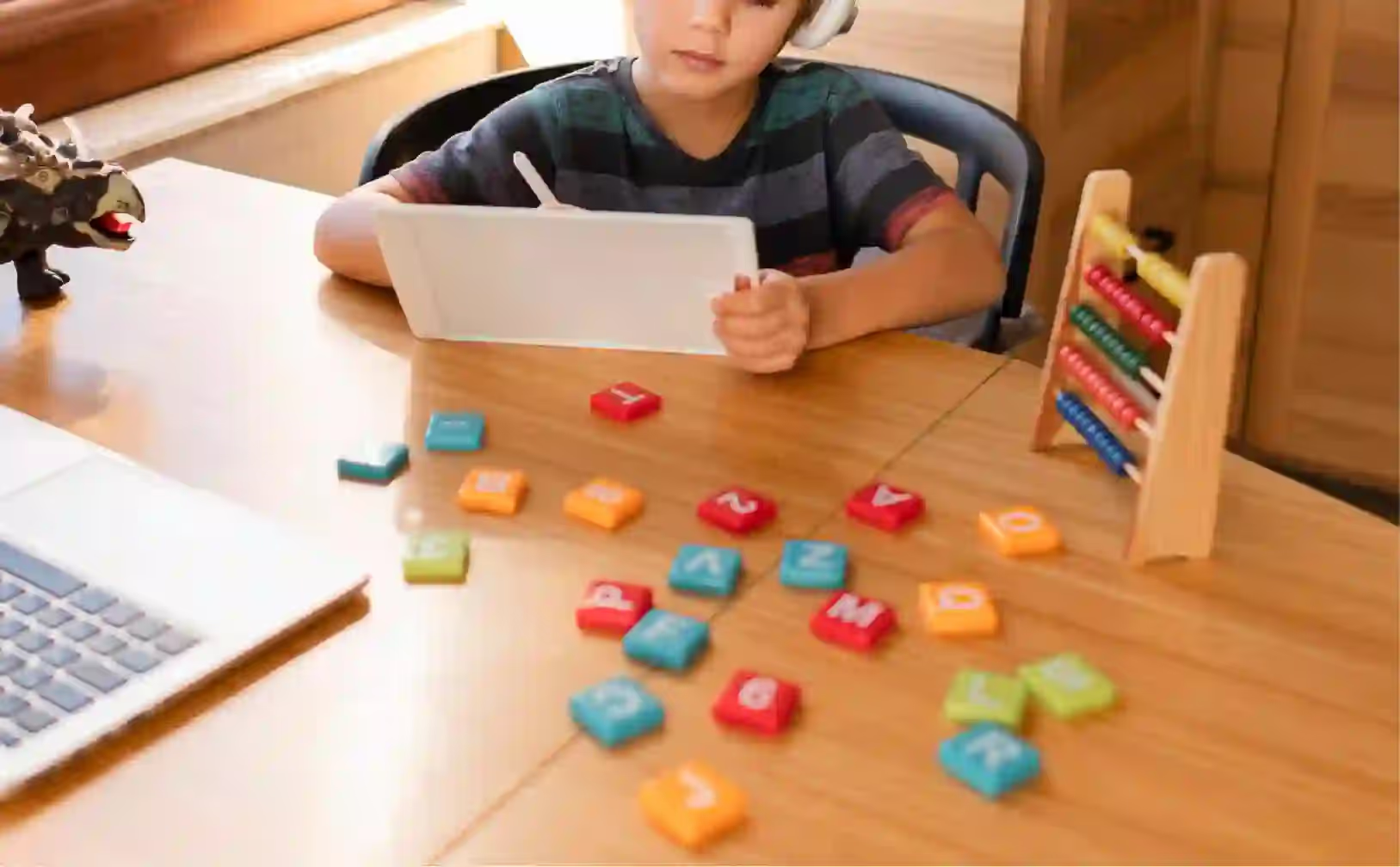
The most powerful learning often doesn't feel like learning at all—it's just life, but with a parent who notices and highlights the learning embedded in everyday activities.
Grocery shopping becomes applied mathematics when children help plan meals, compare prices per unit, estimate total costs, calculate discounts, and stay within budget. It becomes nutrition science when discussing food groups and reading nutrition labels. It becomes reading practice through labels, signs, and lists. A grocery trip might take fifteen minutes longer when you're actively using it as learning time, but that's fifteen minutes of engaged, applied learning that replaces thirty minutes of homework worksheet struggle. Let children be responsible for specific items—"You're in charge of finding breakfast items that fit our budget"—which develops independence, decision-making, and all the academic skills embedded in that task.
Cooking together might be the richest learning opportunity available in daily life. Following recipes teaches sequential processing, reading comprehension, and following directions. Measuring ingredients is applied fractions and proportions. Observing cooking processes is chemistry—states of matter changing, Maillard reactions creating flavor, emulsification, crystallization. Doubling or halving recipes is multiplication and division with immediate feedback about accuracy. Timing multiple dishes to finish simultaneously requires planning and time management. Children who regularly cook develop competence, confidence, and life skills alongside academic learning.
Writing letters, thank-you notes, or maintaining journals develops literacy skills in purposeful contexts. A child writing to a grandparent, a deployed parent, or a pen pal is practicing writing, but unlike a writing assignment, they have a real audience and real purpose. This fundamentally changes engagement and quality. Journaling about daily life, observations, feelings, or interests develops writing fluency without the pressure of evaluation. Some children resist writing in school but willingly write pages about topics they choose for purposes they determine.
Garden science experiments offer endless opportunities for authentic investigation. Planting seeds and observing growth demonstrates life cycles, photosynthesis, and plant needs. Comparing growth under different conditions (sun versus shade, watered versus dry, different soil types) is experimental design and data collection. Measuring plant growth over time creates authentic graphing and data analysis. Observing insects and pollinators brings ecology to life. Even a few pots on a windowsill provide opportunities for scientific thinking that worksheets cannot replicate.
Home maintenance and improvement projects when appropriate for age include rich applied learning. Measuring for furniture, calculating paint needed, planning room layouts—all mathematics with real-world application. Understanding how household systems work (plumbing, electrical, heating) brings engineering and physics into daily context. Children who help with real household tasks develop competence and contribution alongside academic skills.
The habit of noticing learning opportunities in daily life serves children far better than homework ever could. Instead of separating learning from living, this approach integrates them, teaching children that curiosity and knowledge apply everywhere, not just in school.
Creating a homework-free learning space requires parents to shift roles from homework enforcer to learning facilitator, and this shift can be challenging.
Setting expectations means being clear about what learning looks like in your home even without traditional homework. This might sound like: "Learning is important in our family, but we believe the best learning happens through exploration, projects, and real-life application rather than worksheets. Here's what I expect to see..." Then describe observable behaviors: engagement with books, curiosity about how things work, willingness to help with household tasks that involve learning, time spent on projects or creative work. Concrete expectations prevent "homework-free" from becoming "learning-free" while maintaining the crucial distinction between authentic engagement and compliance-based homework.
Encouraging autonomy rather than micromanagement represents perhaps the most important parental skill in this model. Your role isn't to direct every learning moment or ensure constant productivity. Children need substantial unstructured time where they might appear to be doing nothing but are actually processing, imagining, and developing independence. Trust that a child staring out the window isn't wasting time—their brain is active even when their body is still. Resist the urge to constantly suggest activities or fill empty time. Boredom is actually valuable—it's often the precursor to creativity and self-directed engagement.
Adopting a "learning is part of living" mindset rather than separating learning time from life time transforms how you interact with your child throughout the day. When you wonder aloud about how something works, when you look up answers to questions together, when you treat mistakes as interesting rather than problematic, when you model your own learning and curiosity—all of this teaches children that learning isn't something that happens only in designated times and places. It's continuous, natural, and intrinsically rewarding.
The research from the American Psychological Association on children's development emphasizes that parental involvement in education matters tremendously, but the quality of involvement matters more than quantity. Sitting with a child forcing completion of homework they hate doesn't constitute quality involvement. Exploring a topic together because you're both curious, supporting a project they're excited about, or simply being available when they want to share something they've discovered—this is the involvement that actually enhances learning and relationships.
Letting go of comparison with other families or with conventional expectations requires conscious effort. You'll see social media posts about other children's science fair projects and wonder if you're doing enough. You'll hear about intensive homework loads in nearby schools and question your choices. Your own parents might express concern that without homework enforcement you're being too permissive. Staying grounded in the research, in your observation of your own child, and in your family's values helps resist the pressure to conform to practices that don't actually serve children well.
A homework-free learning space can be especially liberating for neurodivergent children, but it requires thoughtful adaptation to serve them well.
Children with ADHD often struggle enormously with traditional homework—it hits all their weaknesses (sustained attention, working memory, organization, motivation for non-preferred tasks) while offering none of the supports that help them succeed. A learning environment designed around their strengths looks very different. Movement-integrated learning where physical activity accompanies thinking works far better than seated work. Breaking activities into short segments with clear transitions maintains engagement better than extended sessions. High-interest materials trump comprehensive coverage—better to deeply engage with fewer topics than to skim many. Visual timers and schedules provide external structure supporting executive function. Most importantly, choice and autonomy leverage intrinsic motivation, which ADHD brains desperately need to sustain attention.
Autistic children benefit from predictable routines and clear expectations in their learning space. Visual schedules showing what activities are available, timers showing how long activities will last, and clear organization systems reduce the cognitive load of navigating uncertainty. Special interests become powerful learning vehicles—a child fascinated by trains can learn history through railroad development, geography through rail systems, mathematics through train schedules and speeds, reading through train books. Rather than fighting to broaden interests, leverage them to build skills. Sensory considerations matter significantly—many autistic children need specific sensory input (compression, movement, fidgets) or need sensory protection (quiet, dim lighting, minimal visual complexity).
Children with sensory processing differences need environments carefully calibrated to their needs, which vary dramatically. Some children are sensory-seeking—they need movement, strong input, variety. Provide crash mats, resistance bands, chewy objects, textured materials, and accept that their learning might look active and messy. Other children are sensory-sensitive—they're easily overwhelmed by noise, light, texture, or visual complexity. Create calm spaces with soft lighting, sound dampening, smooth textures, and minimal clutter. Many children are mixed—seeking some types of input while avoiding others. Observe carefully to understand individual patterns.
Children with dyslexia or other learning differences benefit from multi-modal approaches where reading isn't the only pathway to information. Audiobooks, videos, hands-on exploration, and verbal explanation all provide access to content without relying exclusively on skills that are challenging. This doesn't mean avoiding reading but rather ensuring that reading struggles don't prevent learning in all domains. Technology assistive tools like text-to-speech, speech-to-text, or reading overlays can reduce friction and frustration.
Fidget-friendly stations acknowledge that many children need sensory input to focus rather than being distracted by it. A small basket of fidget tools (stress balls, textured objects, small manipulatives) within reach allows self-regulation without requiring permission for each use. This simple accommodation helps many children sustain attention far longer than enforced stillness ever could.
The fundamental insight is that neurodivergent children aren't broken versions of neurotypical children needing to be fixed—they're children whose brains work differently and who need environments designed for their neurology rather than against it. Homework-free learning spaces offer the flexibility to provide this individualization in ways standard homework assignments never could.
Beyond academic considerations, homework-free learning environments produce significant emotional and behavioral improvements that ultimately support learning more effectively than homework ever could.
Reduction in homework-related anxiety often appears within days of eliminating the homework battle. Children who dreaded afternoons and evenings, who cried over assignments, who developed psychosomatic symptoms to avoid homework—these children often transform rapidly when that pressure is removed. The anxiety wasn't about learning itself but about the coercion, the sense of never being done, the conflict with parents, and the feeling of inadequacy when work was difficult. Remove the homework and frequently the anxiety vanishes, revealing a child who actually enjoys learning when it's voluntary.
Increase in self-efficacy—the belief that you're capable of accomplishing things—emerges from experiencing success in self-directed learning. When a child pursues a project they designed, solves a problem they identified, or masters a skill they chose to develop, they experience genuine agency. This is completely different from completing assigned work correctly. One builds confidence and initiative; the other builds compliance. Research published through the National Library of Medicine consistently shows that self-efficacy predicts academic success, career achievement, and life satisfaction more powerfully than grades or test scores.
Improved family relationships represent one of the most immediate and significant benefits families report. When parents are no longer homework enforcers, the entire emotional tenor of evenings changes. Time together can be genuinely enjoyable rather than battleground. Conversations aren't dominated by "have you finished your homework?" Bedtime isn't rushed because homework took too long. Parents can return to their proper role as supporters, encouragers, and resources rather than taskmasters. Children feel accepted rather than constantly monitored and corrected.
Restored time for essential childhood activities—unstructured play, physical activity, creative pursuits, family connection, adequate sleep—produces cascading benefits across all domains. Children with sufficient sleep perform better academically, regulate emotions more effectively, and have better physical health. Children with regular physical activity show improved focus, behavior, and academic performance. Children with time for creative pursuits develop problem-solving skills and experience flow states that build engagement capacity. All of these compete with homework time in traditionally structured homes.
Increased intrinsic motivation for learning might be the most important long-term benefit. When learning isn't something imposed externally and accompanied by stress, children can discover that learning itself is intrinsically satisfying. They develop curiosity as a trait rather than as something teachers try to stimulate during lessons. They become self-directed learners who seek knowledge because they want to understand, not because understanding is required. This internal motivation sustains education throughout life in ways that homework habits never could.
Real Parent Testimonials
Hearing from families who've made this shift helps envision what's possible.
These families share common themes: initial fear and guilt, rapid improvement in family dynamics, children's rediscovery of curiosity and joy in learning, and ultimate conviction that this approach serves their children better than traditional homework ever did.
Materials to Gather:
Seating and Furniture Options:
Routines to Establish:
Daily Learning Prompts:
Reflection Tools:
Creating an effective learning space doesn't require significant investment. The most important elements—time, attention, autonomy, and engagement—cost nothing.
DIY resources often work better than purchased materials anyway. Cardboard becomes building material, forts, display boards, and endless creative projects. Kitchen items serve as scientific equipment—measuring cups, containers, thermometers, timers. Nature provides free materials endlessly—rocks, sticks, leaves, flowers, insects to observe. Scrap paper, old magazines, and recyclables become art supplies. The constraint of working with available materials often sparks more creativity than having everything commercially produced.
Dollar-store investments provide surprising value. Playing cards, dice, small manipulatives, basic craft supplies, organizational containers, and even some books can be found inexpensively. Science exploration items like magnifying glasses, small measuring tools, and notebooks cost just dollars. Rotate what's available rather than buying everything at once to maintain novelty without constant expense.
Library collaboration might be your most valuable resource. Most libraries offer far more than books—many have museum passes, educational program kits you can check out, STEM materials, maker spaces, and extensive digital resources including streaming educational content and online courses. Librarians are often happy to help assemble resources around specific interests or learning goals. Use libraries not just for books but as learning partners and community resources.
Free online resources abound for families seeking high-quality educational content. Khan Academy offers comprehensive lessons across subjects, entirely free. PBS has extensive online educational content. YouTube, despite its flaws, hosts incredible educational channels when you're selective. Edutopia provides research-backed strategies and activities families can implement.
Community resources often go underutilized. Local parks offer nature education programs. Museums have free days and educational programs. Hardware stores sometimes offer kids' workshops. Community gardens, libraries, and recreation centers all provide free or low-cost learning opportunities. Universities occasionally open labs or lectures to community families. Exploring what's available in your specific community often reveals unexpected learning resources.
The most significant investment isn't financial—it's time and attention. Being present, noticing learning opportunities, supporting interests, and protecting space for self-directed exploration cost nothing but matter more than any material purchase.
Several persistent myths prevent families from embracing homework-free approaches despite evidence supporting them.
Dismantling these myths requires trusting research over cultural assumptions and trusting your observations of your own child over generic pronouncements about what children need.
Success in a homework-free learning environment looks different from traditional metrics, requiring attention to different indicators.
Soft skills like curiosity, persistence, creativity, and self-direction matter more for long-term success than test scores but are harder to measure. Watch for your child asking questions spontaneously, pursuing topics independently, persisting through challenges in projects they care about, making connections between different areas of knowledge, and choosing to learn during free time. These indicators suggest developing internal motivation—the trait that predicts continued learning throughout life.
Curiosity specifically deserves attention. Is your child asking "why" and "how" questions? Are they noticing things in their environment and wondering about explanations? Do they initiate learning rather than waiting for assignments? Curiosity isn't measured by standardized tests but predicts learning outcomes better than intelligence or prior knowledge.
Academic feedback from teachers and standardized testing still provides information, just not the complete picture. Most children in homework-free environments maintain or improve academic performance, but even if test scores don't rise dramatically, consider whether those scores meaningfully predict what matters—capability, adaptability, problem-solving, creativity. Use academic feedback as one data point among many, not the primary success measure.
Emotional regulation and wellbeing might be the most important success measures. Is your child generally happy? Do they enjoy learning? Are family relationships positive? Is there time for play, rest, and connection? A child who's emotionally healthy but scores slightly lower on standardized tests is vastly more successful than one who achieves perfect scores while anxious, stressed, and disengaged from learning.
The long view matters more than immediate performance. Are you developing a child who loves learning, who's curious about the world, who can teach themselves new things, who persists through challenges? These qualities predict adult success, satisfaction, and continued growth far better than any childhood test score.
Ready to make this shift? Here's a concrete implementation plan.
The homework battle consuming your evenings isn't inevitable. The tears and frustration aren't necessary prices for education. The growing tension in your relationship with your child over worksheets isn't preparing them for future success—it's undermining the very qualities that predict long-term achievement and life satisfaction.
Learning doesn't start at a desk, and it definitely doesn't end when the school bell rings. The most powerful learning happens when children are genuinely engaged, when they're pursuing questions that matter to them, when they're applying skills in meaningful contexts, and when they experience the deep satisfaction of figuring something out because they wanted to know, not because someone demanded they demonstrate knowledge.
Creating a homework-free learning space means trusting research over convention, trusting your observations of your child over generic assumptions about what all children need, and trusting that education can be peaceful, joyful, and effective without coercion. It means recognizing that childhood is short, that relationships matter more than worksheets, and that developing curious, capable, emotionally healthy humans is the actual goal—a goal traditional homework often undermines rather than supports.
You don't need expensive materials or special expertise. You need time protected from homework battles, attention to your child's interests, willingness to see daily life as rich with learning opportunities, and courage to buck convention when convention isn't serving your child well. You need to believe that your child's natural curiosity, given space and support, will drive learning more effectively than external assignments and punishments.
The evidence supports this approach. The families implementing it report transformative changes. The children thriving in homework-free environments demonstrate that learning—real, deep, meaningful learning—flourishes when it's voluntary, when it's interesting, and when it's integrated into a life that includes play, rest, connection, and joy.
Your child deserves to love learning. Your family deserves peaceful evenings. You deserve to be your child's supporter rather than their taskmaster. Education can be all of this—effective, engaging, and enjoyable—without the homework stress you've been told is necessary.
Start today. Protect an hour tonight from homework and spend it playing a game together, reading something interesting, cooking dinner while talking about what you're doing, or simply being together without agenda. Notice what happens. Notice your child's face, your relationship, the quality of your time together.
Learning without homework isn't lowering standards—it's raising them to what actually matters: developing humans who are curious, capable, resilient, and genuinely educated rather than just practiced at compliance. That's the real work. Everything else is just worksheets.
Related posts
AI is already part of homework. Learn how to help your child use tools like ChatGPT safely and effectively—supporting learning, not replacing it.
How to tell if your child’s school is using effective phonics-based reading instruction—or relying on guessing strategies that can cause long-term reading failure.
Worried your preschooler’s struggles with numbers are more than “just a phase”? Learn early signs of dyscalculia, what’s typical vs concerning, and how early support can change their trajectory.
Born in August, starting school at barely 4? Discover how the 11-month gap affects learning and confidence, your rights on delayed entry, and evidence-based support strategies.
Is nightly homework really helping your 6-year-old—or just stealing sleep, play and peace? Explore research, global practices and parent strategies to push back.