

The Real Impact of Screen Time on Primary Learning: What Research Says in 2025
Learn what current research reveals about screen time, how it affects primary-age learning and focus, and how to build healthy digital habits for your child.
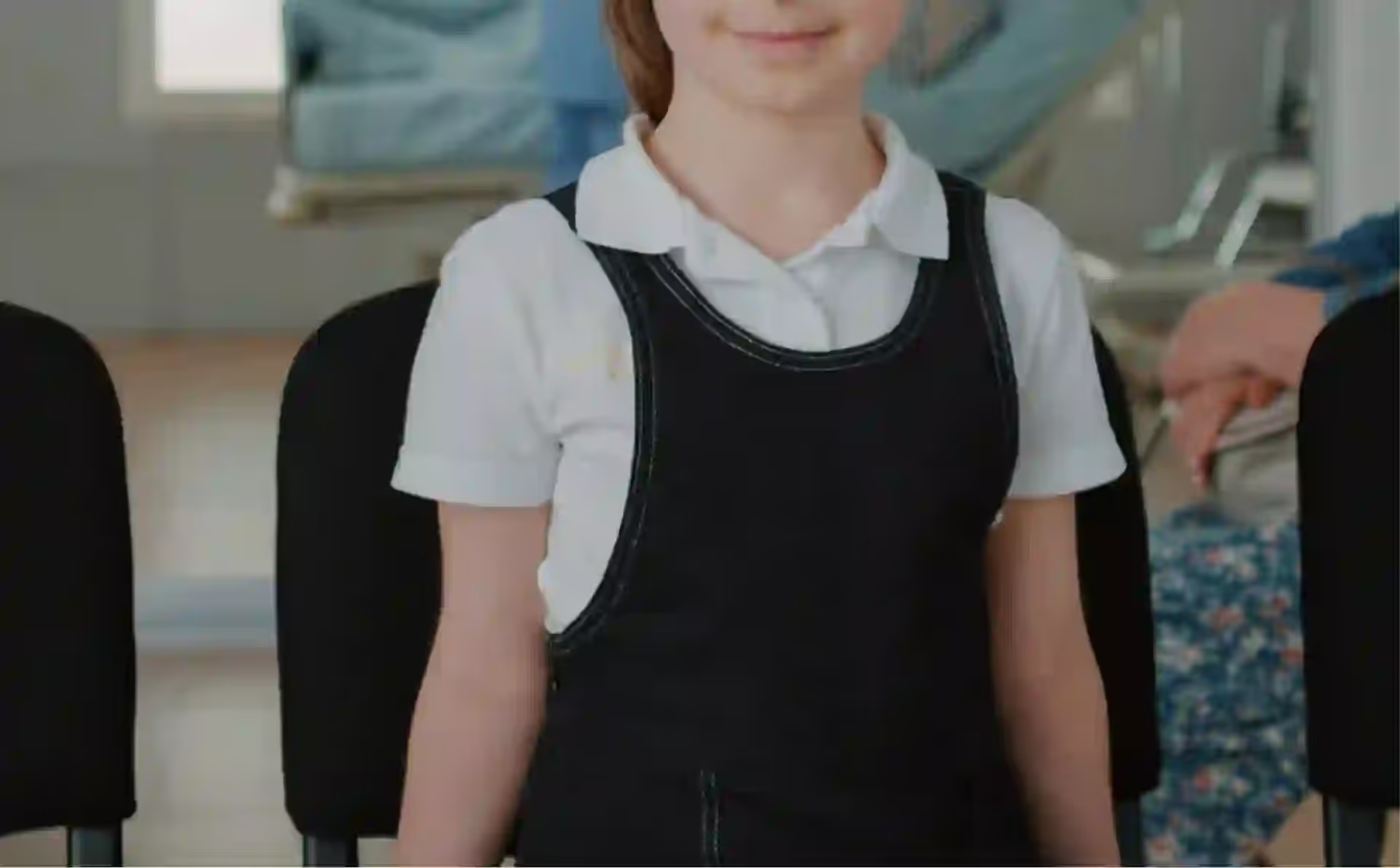
Two elementary schools sit across the street from each other. At the first, a sea of navy polo shirts and khaki pants flows through the entrance—orderly, uniform, quiet. At the second, a kaleidoscope of colors, patterns, and styles bounces up the steps—energetic, individual, loud.
Which school has better behavior? Better academic outcomes? Less bullying? More engaged students?
If you answered the uniformed school, you're thinking what most people think. You're also possibly wrong.
The question of whether school uniforms actually improve behavior has become one of education's most persistent debates, fueled by intuition that seems obvious—of course matching clothes create order—but contradicted by research that's far more complicated. Parents attending school board meetings argue passionately on both sides. Administrators point to improved discipline statistics after implementing uniforms. Students complain about lost freedom and self-expression. And researchers? They keep finding that the relationship between what students wear and how they behave is much less clear than anyone wants to admit.
School uniforms became a prominent policy tool in American education during the 1990s, driven by concerns about safety, gang colors, and the increasing commercialization of childhood. President Bill Clinton's 1996 State of the Union endorsement of uniforms as a violence-reduction strategy gave the movement national visibility and legitimacy. Districts struggling with discipline problems saw uniforms as a quick, visible intervention that required no curricular changes, no teacher training, and no sustained investment in the messy, complex work of actually addressing behavioral root causes.
Twenty-five years later, according to National Center for Education Statistics data, approximately 20% of public schools require uniforms, with substantially higher percentages in urban districts and schools serving predominantly low-income populations. Private schools have maintained traditional uniform requirements at much higher rates. The question is whether these policies deliver what they promise—or whether we're seeing performance of discipline rather than actual behavioral improvement.
This isn't a simple question with a simple answer. The psychology of how clothing affects behavior is real. The social dynamics uniforms create or eliminate matter. The symbolic meaning of dress codes has genuine impact. But so do dozens of other factors that determine whether children behave well, engage with learning, treat each other kindly, and develop into thoughtful, regulated humans. Uniforms might be part of the equation. They might be irrelevant. Or they might actually be counterproductive for some students while helpful for others.
This article will examine what research actually shows, what psychology reveals about clothing and behavior, what schools experience when they implement uniform policies, and most importantly, how to think clearly about whether uniforms serve children's development or simply make adults feel like something is being done about behavior challenges.
Understanding why schools turn to uniforms helps contextualize what they're hoping to achieve and whether those hopes are realistic.
According to U.S. Department of Education data and analysis, schools implementing uniform policies most commonly cite discipline and safety as primary motivations, followed by reducing socioeconomic competition and creating school identity. The interesting question is whether these intended outcomes actually materialize—or whether uniforms primarily make adults feel like they're addressing problems without tackling root causes.
Before evaluating whether uniforms work, we need to understand the real psychological effects of clothing on behavior and cognition.
Enclothed cognition describes how the clothes we wear actually influence our psychological processes. Research published by the Association for Psychological Science demonstrates that clothing affects not just how others perceive us but how we think and behave. In classic studies, participants wearing white lab coats showed improved attention and careful thinking compared to those in street clothes. The effect wasn't just about wearing special clothing—it was specifically about wearing clothing associated with particular roles and qualities.
The mechanism involves both symbolic association (we associate certain clothes with certain traits and behaviors) and embodied cognition (the physical experience of wearing clothes affects our mental state). When children put on school uniforms associated with being a student, they may unconsciously activate mental schemas about what "being a student" means—hopefully including qualities like focus, respect, and engagement with learning.
Behavioral priming through dress suggests that uniforms could function as environmental cues triggering school-appropriate behavior. Just as putting on pajamas helps adults wind down for sleep or putting on workout clothes helps activate exercise motivation, putting on school uniforms might help children shift into "school mode" mentally and behaviorally. The uniform becomes a costume for the role of student, making associated behaviors more accessible and natural.
This priming effect depends heavily on what associations children have with their uniforms and the school itself. If school is experienced as positive, engaging, and safe, uniforms might prime positive behavior. If school is experienced as oppressive, boring, or stressful, uniforms might actually prime resentment and resistance.
Conformity and social identity effects are well-documented in psychology. When groups dress alike, individuals tend to adopt group norms more strongly and feel increased sense of belonging. This can be positive—students feeling connected to their school community—or concerning—students suppressing individuality to fit in even when group norms are problematic. Uniforms make group membership visually obvious and may strengthen in-group identification while potentially increasing out-group hostility toward students from other schools.
Self-perception and confidence are also affected by clothing. Research shows that what we wear influences how confident, professional, or authoritative we feel. For some students, uniforms might increase confidence by removing anxiety about clothing choices and appearance. For others, uniforms might decrease confidence by forcing them into clothes they feel uncomfortable in or that don't align with their identity.
The challenge is that these psychological effects are real but variable. They work differently for different people in different contexts. What's empowering for one student might be oppressive for another. What helps one child focus might make another feel restricted and resentful. Psychology doesn't deliver a verdict that uniforms always help or always harm—it reveals that clothing affects us psychologically in ways that depend enormously on individual and contextual factors.
Parents and administrators considering uniform policies want clear answers from research: do uniforms improve behavior or not? The frustrating truth is that research delivers mixed messages that don't support strong claims in either direction.
Studies showing modest positive effects exist but typically find small improvements in specific outcomes rather than dramatic transformation. Some research reports:
However, these studies face methodological challenges. Schools implementing uniforms often simultaneously implement other changes—new leadership, stricter discipline policies, increased security, revised curriculum. Isolating the uniform effect from these confounding variables is nearly impossible. When schools invest heavily in uniform policies, they're often also investing in other improvements, making it unclear what's actually driving any observed changes.
Studies showing no significant effects are equally common. Research examining long-term outcomes often finds:
According to comprehensive research reviewed by the Education Commission of the States and research from the National Association of Secondary School Principals, the evidence base supporting uniform policies is surprisingly weak given their popularity. Most studies are correlational rather than experimental, making causation impossible to determine. Sample sizes are often small. Follow-up periods are short. And publication bias likely means positive findings get published while null findings don't, skewing the literature toward overstating benefits.
Large-scale analyses paint an even more ambiguous picture. When researchers examine data from thousands of schools nationwide, uniform policies show little consistent relationship with student outcomes after controlling for school characteristics, student demographics, and other policies. This suggests that whatever uniforms do or don't do, the effects are small enough that they get lost in statistical noise when examining large datasets.
Key findings from major studies:
The pattern emerging from research is that uniforms might be a small piece of a larger puzzle, potentially helpful in specific contexts when implemented thoughtfully as part of comprehensive school improvement, but not a magic solution to behavior problems or a substitute for actual relationship-building, quality instruction, and genuine discipline systems addressing root causes.
This is where the uniform debate gets really interesting: even when schools see apparent behavior improvements after implementing uniforms, determining causation is nearly impossible.
Consider a typical scenario: A middle school struggling with discipline problems implements a strict uniform policy. Simultaneously, they hire a new principal known for strong leadership, implement a restorative discipline program, increase counseling staff, and create clearer behavioral expectations. The following year, behavior referrals decrease by 30%.
The school credits uniforms. But what actually caused the improvement? The new leadership? The increased counseling? The clearer expectations? The restorative practices? The uniforms? Some combination? Impossible to tell from this natural experiment, yet schools confidently attribute success to the most visible change: uniforms.
This is the confounding variable problem that plagues uniform research. Schools rarely implement uniforms in isolation. They're typically part of a package of changes aimed at improving discipline and culture. When improvements occur, uniforms get credit even when other interventions likely deserve it.
Additionally, there's the Hawthorne effect—the phenomenon where people change behavior simply because they know they're being observed or because something new is happening. When schools implement uniform policies with great fanfare, communicate high expectations around the change, and closely monitor compliance and behavior initially, students may temporarily improve behavior simply because attention and expectations have increased. This initial improvement often fades as uniforms become routine and the heightened attention dissipates.
Performance compliance versus genuine improvement represents another crucial distinction. Students may learn to perform good behavior when adults are watching (during school hours in uniform) without actually developing better self-regulation, emotional control, or genuine prosocial motivation. They behave during inspection—when appearance matters—but revert to problematic behavior outside school or during less-supervised times. This creates the appearance of improvement while doing little to build actual behavioral competence.
The Symbolic vs. substantive change problem is that uniforms are highly visible, creating the sense that the school is "doing something" about behavior problems. This visibility satisfies adult desire for action even when the action doesn't address root causes. A school implementing uniforms gets credit for being serious about discipline. A school investing in counseling, teacher training, and relationship-building does harder, less visible work that may actually matter more but seems less dramatic.
Research from the Brookings Institution on educational policy implementation suggests that highly visible reforms often receive disproportionate credit relative to their actual impact, while less visible but more effective interventions go underappreciated. Uniforms fit this pattern perfectly—maximum visibility, questionable effectiveness.
The uncomfortable possibility is that when uniforms appear to improve behavior, they're often proxies for other changes: schools that implement uniforms are often schools taking discipline seriously, setting clear expectations, and investing in school culture. The uniform policy signals these broader commitments but isn't necessarily causing improvements itself.
Beyond behavior, uniforms affect how children think about themselves and their developing identities—effects that matter for wellbeing even if they don't show up in discipline statistics.
Potential positive effects on confidence and equality:
Some students genuinely feel more confident in uniforms. When clothing isn't a daily decision requiring fashion knowledge, style sense, or financial resources they lack, relief replaces anxiety. For children from low-income families particularly, uniforms can eliminate daily reminders of economic inequality—everyone wears the same thing regardless of what their family can afford. This can feel equalizing and protective.
Students who struggle with decision-making, executive function challenges, or anxiety around appearance might experience uniforms as helpful structure reducing daily cognitive and emotional load. Instead of decision fatigue about what to wear, they have a clear answer requiring no thought.
Some children report feeling part of a community when wearing uniforms, experiencing belonging and school pride that uniforms symbolize. This is particularly true when school culture is positive and uniforms are associated with achievement and community rather than oppression and conformity.
Potential negative effects on identity and autonomy:
Adolescence is a critical period for identity development—figuring out who you are, what you like, how you want to present yourself to the world. Clothing is one of the primary tools children and adolescents use to express identity, experiment with self-presentation, and communicate to peers. According to research from the American Psychological Association on youth development, this experimentation is developmentally appropriate and important for healthy identity formation.
Uniforms restrict this experimentation, potentially slowing identity development or pushing it into other domains that may be less safe or healthy. The student who can't express themselves through clothing might turn to more extreme hairstyles, body modifications, or online personas where adult oversight is minimal. Suppressing identity expression in one area doesn't eliminate the developmental need—it just redirects it.
For some children, being forced to wear specific clothing feels violating and disrespectful. Children with strong preferences, sensory sensitivities, or developing sense of autonomy may experience uniform requirements as adults imposing control over their bodies and choices without justification. This can create resentment, resistance, and sense of powerlessness that undermines rather than supports healthy development.
Special considerations for neurodiverse children:
Children with sensory processing differences, autism, ADHD, or anxiety disorders may struggle intensely with uniform requirements. Specific fabrics, textures, fits, or styles can cause genuine physical discomfort or distress. Required ties, tight collars, or inflexible waistbands aren't just annoying—they can be genuinely difficult to tolerate for children with sensory sensitivities.
Schools rarely make adequate accommodations for these needs. The standard response—"everyone wears the uniform, no exceptions"—ignores legitimate differences in sensory processing and forces children to either comply despite discomfort or face discipline for violations related to their disability. This creates entirely preventable behavioral problems and school avoidance.
Gender and identity considerations:
Traditional uniform policies often enforce gender binaries—skirts for girls, pants for boys—that can be deeply uncomfortable for gender-nonconforming, transgender, or questioning youth. Having to wear clothing that doesn't align with gender identity creates daily distress and can seriously harm wellbeing. Progressive uniform policies allow students to choose between options regardless of gender, but many traditional policies remain rigidly gendered.
The developmental question is whether uniforms support or undermine the core psychological tasks of childhood and adolescence: developing autonomous identity, learning to make choices and live with consequences, experimenting with self-presentation, and building confidence in one's own judgment. For some children in some contexts, uniforms might support these goals. For others, they actively interfere.
The claim that uniforms reduce bullying by eliminating appearance-based teasing and status competition is one of the most emotionally compelling arguments for uniform policies. It's also one of the most oversimplified.
The theory makes logical sense: If children can't be bullied about their clothes because everyone wears the same thing, one major source of peer cruelty disappears. Low-income children wearing cheaper, less trendy, or less varied clothing won't stand out as targets. Children whose parents lack fashion sense or who can't afford name brands won't face daily reminders of difference.
What actually happens is more complicated. According to research and data from PACER's National Bullying Prevention Center, bullying is a complex social behavior with multiple drivers. Clothing can be one target, but it's rarely the root cause. When clothing as a bullying target is removed, bullies simply shift to other differences—shoes, hairstyles, backpacks, phones, where students live, how they speak, their families, their bodies, their academic performance, or simply their personalities.
Bullying fundamentally stems from power imbalances, lack of empathy, poor social skills, witnessing aggression being rewarded, insufficient adult supervision and intervention, and sometimes from bullies' own experiences of trauma or abuse. Uniforms address exactly none of these root causes. A child who bullies because it gives them social power, because they've learned aggression works, or because they lack empathy will find targets regardless of what everyone wears.
Evidence on uniforms and bullying is mixed:
Some studies report modest decreases in appearance-based teasing after uniform implementation. This makes sense—if everyone wears the same thing, clothing becomes less available as a target. However, these same studies typically show no change in overall bullying rates, just shifts in what bullies focus on.
Other research finds no relationship between uniform policies and bullying prevalence. Schools with and without uniforms report similar bullying rates when other factors are controlled. This suggests uniforms aren't meaningfully protective against bullying generally.
Some concerning research even finds increased bullying in uniformed schools, potentially because:
The nuanced reality:
For some vulnerable students, uniforms might provide relief from one source of daily stress and social comparison. A child who wore the same outfit multiple times weekly due to limited wardrobe might feel less conspicuous in uniform. A student from a chaotic home who struggles with appropriate clothing choices might appreciate the clarity and structure.
However, truly addressing bullying requires:
Uniforms might play a small supporting role in comprehensive anti-bullying efforts by removing one target for cruelty, but they can't substitute for actual bullying prevention programming, relationship-building, and culture change.
If uniforms aren't the answer to behavior problems, what is? Understanding the real drivers of student behavior helps clarify how to actually support positive conduct.
Relationship with teachers emerges consistently across research as the most powerful predictor of student behavior. Children who feel known, respected, and cared for by teachers engage more positively with learning, follow classroom norms more readily, and show fewer behavior problems. This relationship-building requires time, skill, and genuine care—things that can't be manufactured through dress codes.
Classroom environment and management matter enormously. Well-managed classrooms with clear expectations, consistent routines, appropriate pacing, engaging instruction, and minimal wasted time have fewer behavior problems regardless of what students wear. Conversely, chaotic classrooms with unclear expectations, inconsistent discipline, boring instruction, and ineffective management generate behavior problems that no uniform policy can fix.
Emotional regulation skills and support predict behavior better than clothing. Children who've learned to identify emotions, calm themselves when upset, solve problems constructively, and ask for help when needed behave better in all contexts. Schools supporting this development through social-emotional learning, counseling services, and trauma-informed practices see genuine behavior improvements.
According to research from the Child Mind Institute, children's behavior reflects their emotional state, relationship quality, skill development, and environmental demands. Addressing behavior requires understanding and responding to these factors, not just mandating particular clothing.
Peer dynamics and social belonging profoundly affect behavior. Children who feel accepted, have friends, and believe they belong behave more positively. Those feeling rejected, isolated, or socially unsafe act out, withdraw, or create disruption seeking attention. Creating inclusive school cultures where all students feel valued does more for behavior than uniform policies.
Autonomy and voice also matter. Research consistently shows that children given appropriate autonomy, choice, and voice show better self-regulation and fewer behavior problems than those subjected to excessive external control. Schools that invite student input, allow meaningful choices, and respect student agency see better behavior than those demanding rigid compliance without explanation or negotiation.
Effective discipline systems that teach rather than punish, that address root causes rather than just consequences, and that maintain relationships while holding students accountable produce lasting behavior improvement. Restorative practices, positive behavior interventions, and trauma-informed approaches work. Zero-tolerance policies, harsh punishments, and shame-based discipline don't.
Family engagement and support predict student behavior powerfully. Children from families actively engaged in their education, maintaining high expectations while providing emotional support, show better behavior regardless of school policies. Schools that partner with families rather than blaming them see better outcomes.
Developmentally appropriate expectations prevent behavior problems before they start. Asking kindergarteners to sit still for hours produces behavior problems that reasonable movement breaks would prevent. Expecting middle schoolers to show no signs of adolescence creates problems that developmentally informed expectations would avoid.
The pattern is clear: behavior improves through relationships, skill-building, developmentally appropriate environments, effective teaching, family partnerships, and genuine respect for students. Uniforms touch none of this. They might accompany these more substantive interventions, might even symbolize a school's commitment to creating positive culture, but they don't replace the actual work of supporting children's behavioral development.
Examining specific school experiences helps illustrate the complex realities of uniform policies beyond abstract research findings.
Case Study A: Urban Elementary School
Washington Elementary, serving predominantly low-income students in a large city, implemented uniforms alongside comprehensive school reform. The new principal instituted morning meetings building community, revised discipline policies toward restorative approaches, hired additional counselors, and increased family engagement. Uniforms were presented as part of creating a new culture of excellence and pride.
Year one showed dramatic improvements: behavior referrals decreased 40%, attendance improved, and parent satisfaction increased. The district credited uniforms as a success story. However, school staff privately acknowledged that the comprehensive changes probably mattered more than clothing. The uniforms signaled that change was happening and helped everyone take the reforms seriously, but the actual behavior improvements seemed more connected to increased counseling, better relationships, and more effective discipline systems.
By year three, initial improvements had plateaued. Behavior was better than before reforms but hadn't continued improving. Some students and families chafed under uniform rules, creating new conflicts. The principal concluded that uniforms had been a useful symbolic tool during transition but weren't driving ongoing improvement—that required sustained work on relationships, culture, and support systems.
Case Study B: Suburban Middle School Without Uniforms
Lincoln Middle School deliberately chose not to implement uniforms despite district pressure, instead investing in comprehensive social-emotional learning programming. Every student participated in weekly advisory groups focusing on emotional regulation, conflict resolution, empathy, and community-building. Teachers received extensive training in trauma-informed practices and relationship-based classroom management.
Despite allowing students to wear their own clothes (within reasonable dress code), the school saw significant behavior improvements over three years. Suspensions decreased 60%, bullying reports declined, and school climate surveys showed dramatic positive changes. Students reported feeling more connected to teachers and peers, better able to handle stress and conflict, and more engaged with learning.
The principal attributed success to investing in relationships and skills rather than external control. "We decided to work on the actual causes of behavior problems rather than trying to manage them through dress codes. It's harder work but it's effective work."
Case Study C: Charter School Uniform Backlash
Jefferson Charter School implemented strict uniforms as part of their "college prep" brand. Polos, khaki pants, closed-toe shoes, strict hair guidelines. Parents initially supported the policy, believing it created academic seriousness. Students complied superficially but resentment built.
By second year, the school faced growing problems: students found creative ways to resist (wearing required items in non-compliant ways, protesting through accessories), parent complaints increased about costs and inflexibility, several students with sensory issues experienced genuine distress leading to school avoidance, and enforcement consumed administrative time and energy while creating adversarial relationships.
Most concerningly, actual learning and behavior weren't improving. Test scores stagnated, behavior problems persisted (just manifesting in ways other than clothing violations), and school culture felt rigid and joyless. The administration had focused so heavily on uniform compliance that they'd neglected actual instructional quality and relationship-building.
A new principal gradually relaxed uniform requirements while implementing more substantive improvements to teaching, support services, and school culture. Behavior and achievement both improved as the school focused less on appearance and more on substance.
These case studies illustrate that uniform policies exist within larger school contexts. They can accompany positive change but rarely drive it themselves. Schools that improve do so through substantive work on relationships, teaching, and culture—with or without uniforms.
If your school is considering implementing uniforms, asking the right questions helps ensure thoughtful decision-making rather than symbolic action.
About goals and measurement:
About implementation:
About alternatives:
About ongoing evaluation:
Red flags suggesting poor implementation:
Thoughtful schools approach uniforms as one potential tool requiring careful implementation, adequate support, and ongoing evaluation. Schools treating uniforms as simple solutions to complex problems are likely to be disappointed by results and may create new problems through implementation.
Advantages of School Uniforms
✓ Reduces visible fashion competition and brand pressure
✓ May simplify morning routines and eliminate clothing arguments
✓ Can create visual symbol of school unity and identity
✓ Potentially reduces some appearance-based teasing
✓ May help some students feel less judged or anxious about appearance
✓ Creates clear expectations about appropriate school dress
✓ Can support "school mode" behavioral priming for some students
✓ Eliminates some distractions related to provocative or inappropriate clothing
Disadvantages of School Uniforms
✗ Suppresses self-expression and identity development
✗ Creates financial burden, particularly for low-income families
✗ Doesn't address root causes of behavior problems
✗ May increase resistance and resentment in some students
✗ Can be uncomfortable or distressing for children with sensory issues
✗ Potentially discriminates against cultural or religious dress
✗ Traditional policies often enforce rigid gender norms
✗ Shifts status competition to other markers (shoes, accessories, possessions)
✗ Consumes administrative time enforcing compliance
✗ May create appearance of improvement without substance
✗ Reduces student autonomy and voice
The balance of these factors depends heavily on individual student needs, school context, implementation quality, and what other supports exist. Uniforms are neither universally good nor bad—they're complicated interventions with real trade-offs.
Educational researchers and child development experts increasingly question whether uniform policies deserve the attention and resources they receive.
Dr. David Brunsma, sociologist who has studied uniforms extensively, concludes that research simply doesn't support strong claims about uniform benefits. "After controlling for other factors, uniforms show minimal effects on the outcomes schools care about most. They're not harmful generally, but they're not the solution schools are looking for either."
Child psychologists emphasize that adolescent identity development requires some freedom for self-expression. Dr. Lisa Damour, clinical psychologist specializing in adolescence, notes: "Clothing is one of the primary ways teenagers experiment with identity. Completely eliminating this avenue of expression doesn't eliminate the developmental need—it just pushes it elsewhere, sometimes in less healthy ways."
Education policy experts suggest that uniform discussions often distract from more important conversations about school quality. The time and political capital spent debating uniforms could be spent on teacher quality, curriculum, counseling services, class sizes, or other factors with stronger evidence bases for improving student outcomes.
Flexible uniform codes allowing choice within parameters (multiple color options, style choices, different bottoms) maintain some uniformity while respecting individuality and reducing gender rigidity.
Student voice in policy development ensures that those most affected by uniform rules have input into creating them, increasing buy-in while respecting student autonomy.
Focus on substance over appearance shifts attention from what students wear to what they learn, how they're supported, and whether they're thriving emotionally and academically.
Evidence-based policy evaluation requires schools to measure whether uniforms produce intended outcomes and modify or eliminate policies that don't deliver results.
The future likely involves less absolutism—fewer districts mandating strict uniforms without evidence while fewer critics treating any dress standards as oppressive. More schools will develop flexible, inclusive dress expectations that balance concerns about appropriate school dress with respect for student autonomy and diversity.
Walk back to those two schools from the introduction—one uniformed, one not. Now you understand that you can't determine which has better behavior, stronger culture, or more effective education by looking at what students wear.
The uniformed school might have excellent behavior because of strong leadership, effective teaching, comprehensive support systems, and positive relationships—with uniforms being a small piece of that picture or simply accompanying other changes. Or it might have compliance-focused culture prioritizing appearance over substance, with behavior problems simmering beneath surface conformity.
The non-uniformed school might have chaotic culture and ineffective management creating behavior problems that adults wish uniforms would solve. Or it might have vibrant, engaged, self-regulated students thriving in an environment respecting their autonomy while teaching them responsibility.
Clothing influences behavior through psychological mechanisms that are real but variable and context-dependent. For some students in some settings, uniforms provide helpful structure, reduce anxiety, and support positive behavior. For others, they feel restrictive, suppress identity development, and create resentment without improving self-regulation.
The research doesn't support the strong claims uniform advocates make about dramatic behavior improvements and transformed school culture. It also doesn't support claims that uniforms are inherently harmful. What research does show is that uniforms are a small, complicated piece of the educational puzzle—potentially helpful in specific contexts when implemented thoughtfully, but not a substitute for the actual work of supporting children's development.
Uniforms may change appearances, but only relationships change behavior. Schools improve when adults build genuine connections with students, when teaching engages rather than bores, when discipline teaches rather than punishes, when support systems address root causes of struggles, and when culture values every child's wellbeing and growth. These are hard things requiring sustained investment, skills development, and genuine care. They're also the things that actually matter.
If uniforms accompany this substantive work, they might add small value or at least do little harm. If uniforms substitute for this work—if schools believe that making everyone dress alike will solve behavior problems without addressing relationships, teaching quality, support services, and culture—they're pursuing illusion rather than improvement.
The choice to support or oppose uniform policies should be informed by understanding their actual effects and limitations, by considering your specific child's needs and your school's context, and by recognizing that what students wear is far less important than how they're taught, how they're treated, and whether they're genuinely supported in developing into thoughtful, regulated, capable humans.
The fabric of education isn't made of polo shirts and khaki pants. It's woven from relationships, skill-building, respect, high expectations paired with warm support, and genuine commitment to every child's flourishing. Focus on that fabric, and what students wear becomes the minor detail it actually is.
Related posts
Learn what current research reveals about screen time, how it affects primary-age learning and focus, and how to build healthy digital habits for your child.
Learn how to understand and handle school refusal in primary-aged children: key causes, practical strategies, and when to seek professional help.
A practical guide to packing nut-free school lunches that are safe, affordable, and actually eaten—plus tips for label reading, picky eaters, and reducing parent stress.
How to recognise your child’s progress during their first school term, support their emotional adjustment and celebrate small wins that build long-term confidence.
Your child says they have no friends and eats lunch alone. Learn what children really mean, how to decode their words, and practical steps to help them build friendships.